




Crop storage event helps minimise risk in difficult season
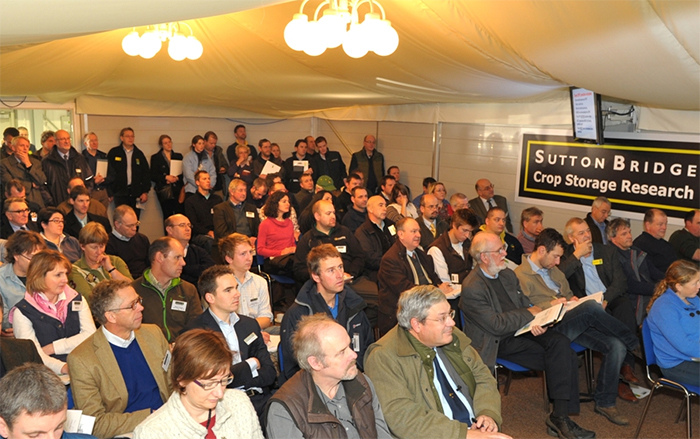
This year’s storage event held at the Potato Council’s world-leading research centre at Sutton Bridge saw over 200 growers, suppliers and industry experts gather to find out the latest in crop storage research.
The 2012 Storage Day, sponsored by Crop Systems and Restrain, covered all aspects of the key issues facing crop storage.
Workshops included:
· Tips on making changes which impact storage efficiency from Potato Council’s Adrian Cunnington, Head of Sutton Bridge Crop Storage Research
· Advice on how to meet stewardship requirements for chlorpropham (CIPC) sprout suppressant from David Hudson, Technical Editor of the Red Tractor Farm Assurance Potato Protocol
· A wider look at development opportunities for storage of field vegetables from Emma Garrod, Research Agronomist at leading grower and supplier Produce World.
Mr Cunnington said: “Positive ventilation is the best way to dry out potatoes in the weather conditions experienced this season. However, many stores are having to make do with the non-positive systems they have in place. Whilst we can’t knock down old box stores and start from scratch, growers can convert them to suction system or put in air dividers – these measures can greatly improve the air movement in store.”
Concerns were raised over the levels of CIPC being used in potato storage. Mr Hudson warned attendees: “If there are any more Maximum Residue Level (MRL) exceedances detected, we will see greater restrictions on CIPC use. Most refrigerated stores only need one application – even when keeping potatoes to June.”
Mr Cunnington added: “CIPC works best at temperatures of 7°C-10°C. At low temperature it vapourises less easily so it is important to apply it uniformly to get good control as it won’t re-distribute round the store as well at 3.5°C. Fan-assisted application has shown the best results in trials but we need growers to change their stores to benefit from this.”
Two Q&A panels were held in collaboration with the Potato Processors’ Association (PPA), which represents the potato interests of manufacturers of frozen and chilled potato products and crisps in the UK, and the Fresh Potato Suppliers’ Association (FPSA), which represents all nine major packers of potatoes to the UK’s top five supermarkets.
Richard Harris, director general of the PPA, said: “Now 57% of potatoes consumed in Britain are in the processed form. It was 52% last year and the market is expanding. We’re doing extremely well and that’s good for farmers, for producers and the country.”
David Walker, chairman of the FPSA said: “The future use of CIPC is our hands. We must be more stringent in our application process including asking ourselves, is the store suitable for CIPC?” He continued, “we are continuing R&D to find more effective application methods and alternative products used alone or in combination.
“To secure the sustainable supply of fresh potatoes throughout the year we need to see a premium for the management and capital investment in storage.”
Simon Bowen, Agronomy Director at Produce World, told attendees about the ways the company is looking to reduce CIPC usage through innovation. Produce World is using ethylene technology for sprout suppression and is testing it in pack as a sachet to extend control on to the retail shelf.
He said that the wet conditions and very long storage could mean problems with blackheart. “At one time, I never thought it was a big problem for the industry but last season they were quite widespread problems with Maris Piper when blackheart developed after packing,” said Mr Bowen.
The next dates for growers’ diaries are the Storage Forums in Scotland on February 26, 2013 and on February 28, 2013 at Sutton Bridge.




