




EU threatens legal action against England over free range perching
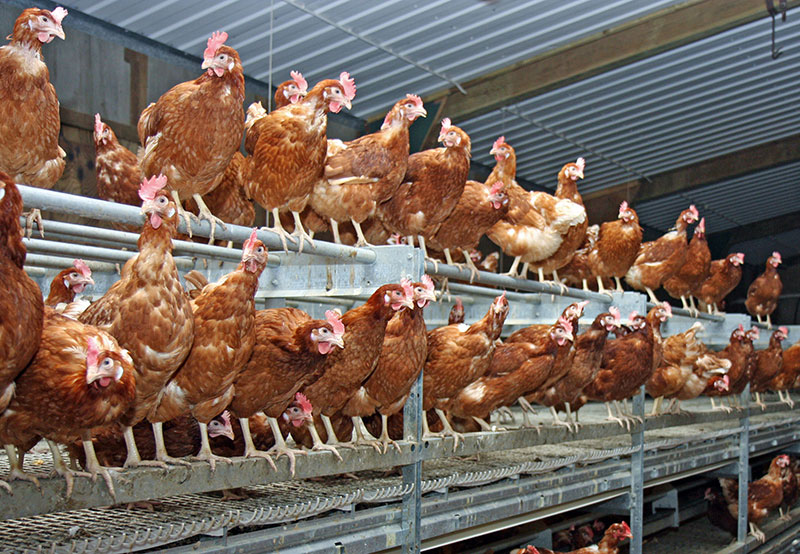
The European Commission is threatening England with legal action over the use of perches in free range egg units.
Brussels has issued the Department for Environment Food and Rural Affairs (Defra) with an official warning letter in a long running dispute over London's interpretation of the European Union's rules on the welfare of laying hens. Whilst English egg producers are allowed to class floor slats as perches in non-cage systems, the Commission insists that they must use aerial perches. Brussels is now threatening to haul Defra before the European court unless it complies with the Commission's interpretation.
Why the Commission has chosen to issue a legal threat at this particular time seems something of a mystery, says Robert Gooch, director of policy with the British Free Range Egg Producers' Association (BFREPA). Robert says the EU already has its hand full trying to enforce the battery cage ban on non-compliant EU states. "I have asked why now, but no-one seems to have an answer," said Robert, who was briefed on developments at a meeting with Defra. Also at the meeting were representatives of the National Farmers' Union (NFU) and the British Egg Industry Council (BEIC).
It is more than two years since Brussels last sought to exert pressure on London. In 2010 Andrea Gavinelli, the head of Unit D5 - Animal Welfare in the Health and Consumers Directorate General of the European Commission, produced a document insisting that slatted floors could not be classed as perches. It was an attempt to establish a definitive interpretation of the EU regulations. However, after receiving a report from ADAS on the practical and financial implications of introducing aerial perches, Defra said it would stand by its own interpretation of the regulations. The ADAS report concluded that installing aerial perches in units in England would cost the industry between £15.5 million and £19.25 million.
At a time when the free range egg sector has been suffering severe financial difficulties as a result of spiralling costs and suppressed prices, having to retrofit aerial perches may prove to be an economic hardship for many producers. Robert Gooch has been asked to provide Defra with up-to-date information about the implications for the free range sector in England. The BEIC is also submitting evidence to the department. "BEIC will be providing data about keel bone damage. I have agreed to provide information on the proportion of the free range flock using perches, either in multi-tier units or through adaptations to single tiers," said Robert, who believes that London may well be in a position to mount a defence against Brussels.
"We will have to get together the detailed figures, but I think we could already be close to the 50 per cent figure," said Robert. According to the ADAS report of 2010, the KAT accreditation scheme in use in Europe required that 50 per cent of perches should be aerial perches. Robert Gooch said that, as far as he was aware, that requirement remained the same. If England was able to show that compliance here was running at about the same level, then the Commission would not, realistically, be able to take legal action against England without taking action against the rest of the EU.
"When you take into account the growth of multi-tier in recent years, I think that would probably get us up to about one third. Other perching will take it up to 45 per cent, I think, but we will have to obtain more detailed figures for Defra," he said. "With multi-tier increasing in popularity the figure will grow. What may happen eventually is that we have to accept that any new units being built will have to use aerial perches, but I don't think we can accept retro-fitting."
The disagreement between Brussels and London is more fraught because the Brussels interpretation has been adopted by politicians in Scotland, where agriculture is a devolved responsibility. Free range egg producers north of the border must comply with the aerial perch requirement. The difference in interpretation between England and Scotland was raised recently at the Scottish Egg Producers Conference Organic and Free Range in Perth, Scotland. During the conference former BFREPA chairman John Retson, a Scottish producer, said that Scottish farmers felt aerial perches were a useful management tool for helping to reduce feather pecking. He asked John Bowler, founder of one of the biggest free range egg producers in the United Kingdom, an English producer and a speaker at the conference, for his views on the perching argument. "It's natural for a bird to perch," said John Bowler. "Birds always go to the highest level, don't they? It's natural."
The legal threat to Defra has been made in the form of a pre-infraction letter from the European Commission. In the letter, the Commission asks for an explanation of why London has not acted in accordance with the Brussels interpretation of the welfare rules. The Commissions has demanded a response by the end of April and has warned that unless it receives a satisfactory reply it will begin legal action. Robert Gooch said he had agreed to provide Defra with up-to-date information on the free range sector by Easter to enable Defra to meet the deadline set in the Commission's letter.




