




Europe will 'buckle' as member states fail to meet cage ban deadline
Half of the hens currently in conventional cages in European Union states will fail to make the switch to enriched cages by the January 2012 deadline, says Mark Williams, chief executive of the British Egg Industry Council.
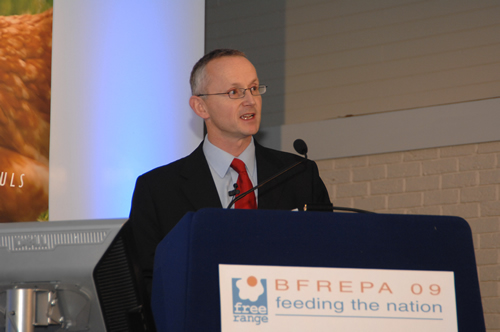
He made the claim during a speech at the annual conference of the British Free Range Egg Producers Association at Stoneleigh Park. New EU rules banning the production of eggs in conventional cages come into force on January 1 2012. Both the EU and the UK Government are currently insisting that the ban will go ahead as planned, but Mark believes that huge numbers of producers in other countries will fail to meet the deadline, raising serious questions about how the EU will react.
"We have reliable reports (anecdotally as well) that half the hens that are in conventional cages in Europe today will not be converted in 2012," he said. "What that means is that 31 per cent of the EU’s hens in theory become illegal on the 1st January 2012. You are all involved in producing eggs. You are pretty savvy about the market and you know very well that Europe will not be shorted with eggs. So what’s going to happen at the last minute is the Commission and the Council of Ministers are going to buckle and they are going to allow those member states who have a big cage industry more time. We in the UK, of course, have been told that we are not going to get more time, so there are certain worries we have. And don’t please think that this is a cage worry. This is one industry and it will affect everybody at the end of the day."
As many as 244 million hens were still in conventional cages across the EU in 2008. They accounted for 63 per cent of EU egg production. The EU figures put free range production at 66 million hens, although Mark said that Romanian back yard flocks were included in the statistics because it "suited the Commission politically" to do so. In comparison, 47 per cent of layers in the UK in 2008 were in conventional cages, eight per cent were in enriched cages and 37 per cent were free range. The forecast is that by 2012 the cage sector will have shrunk to 43 per cent of the market in the UK and free range will account for 50 per cent of the market.
Mark said there was a lot of work going on currently within the UK Government and within Europe to ensure that those people who were investing or who had already invested in enriched cages could benefit from having a different production number. "We have also asked very strongly that there should be an intra-EU trade ban, so that if those member states get more time they do not send those eggs outside their own member state border. For all of you who know how Europe operates, the single market is sacrosanct and nothing will ever impinge upon it. But we will find out how important animal welfare is to the politicians in Europe by the eggy example going forward. Personally, I couldn’t care less what they do in Spain as long as the eggs down there don’t come out of their borders at the beginning of 2012. The last thing we want to see is eggs from conventional cages ending up in the UK after the 1st of January 2012 because it undermines everything this industry is pushing for."
He said the lobbying was taking place jointly with Defra, which was wholly signed up to the industry’s argument. Together with European associations, they put up a powerful voice, although there were some powerful arguments being put up against them. However, the UK Government was committed to the deadline and that would have implications for the free range sector.
"The Minister has come out very clearly and said that UK plc will comply fully with the directive to ban conventional cages from the 1st of January 2012. Your sector, free range, will be half of the UK egg industry. What that means in terms of bird numbers is that your sector will need fourteen and a half million hens. If you work on the premise that you have got between 10 and 11 million at the moment then you can see that expansion is needed. Because if we don’t do it, somebody else will do it for us."
He said that although internal stocking density would be reduced from January 1 2012, two thirds of hens were already stocked at the lower level. Consequently the change would result in a loss of just three quarters of a million birds. "We will easily get that back with the increase in the range stocking density," he said. "If we estimate that we want fourteen and half million birds, we have to make sure that the expansion is managed and it is managed properly. We do welcome Freedom Food following us on the increase in the range stocking density."
He welcomed the Farm Animal Welfare Council taking the view that a ban on beak trimming should not be introduced at the moment, and he expected good news soon on salmonella. The first results from the National Control Programme had not yet been published, although they would show that the level of salmonella on farms was one per cent. "If you bear in mind that the UK was eight per cent in a survey that was done a few years ago this is absolutely fantastic news and it puts us well ahead of any other industries in Europe. It is a real tribute to this industry to have achieved that."
He said the European Safety Authority would publish in January 2010 the results from all member states. He said it would be interesting to see what was happening on the Iberian peninsula and in east European states.




