




Getting serious about biosecurity
By Mike Tyers, regional farms manager, Deans Foods
Every sector or industry meeting, every contingency plan, and every bit of advice in the current climate of avian influenza stresses that the industry's most effective defence in preventing the spread of the disease is biosecurity.
With the increase in free range production over the last 15 years, we have tended to overlook many of the precautions that were common practice in the industry when it was more intensive, but in fact the risks are the same, if not more so.
Avian influenza is somewhat easier to control than other poultry diseases, such as Newcastle disease, as it is primarily transmitted by direct contact with faeces and discharges from infected birds. It is therefore more than likely that if free range birds are ordered to be 'shut-in', following an increased risk, then the most likely way the flock could become infected is if people and materials—which are under the flock keeper's control—take the disease in.
There are a several necessary transmission routes over which the normal producer has little control, such as feed delivery and egg collection, and there is a feeling that while that remains the case there is little point in trying to maintain anything better. But if biosecurity precautions could limit transmission to these alone, it would reduce the risk dramatically and even control of these routes is possible. There is also a perception that where the poultry unit is part of other farm enterprises it cannot be separately protected. It may be difficult but should be considered.
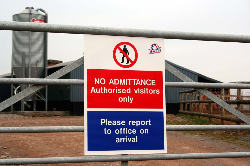
Firstly, I would suggest that access to the site, especially the area where there might be contact with the birds, is restricted. It is much easier to enforce any biosecurity precautions if the number of visitors is minimized. Just think about how many people, including employees, delivery drivers (including postmen), family, reps, auditors and the public in some cases, can approach the poultry unit without any checks or challenges and in many cases you don't know where they have been before they visit you.
When they arrive on the site where should they report and park? You will need to think about how the unit will operate with any such restrictions in relation to other enterprises or interactions. Remember these precautions may need to be in place for some length of time and should be a minimum anyway, so they need to be practical, easy to police and become a routine.
Part of the control of visitors is the use of the visitors' book, a good record in case you, the vet or Defra, need to trace contacts. The imposition of some form of control should limit the number of passes and you should try to reduce the total number of contacts to the site in any given period.
Having controlled your visitors, you can then impose your biosecurity precautions. Vehicles, or at least their wheel arches, should be capable of being sprayed with suitable Defra approved disinfectants. Remember that not all vehicles have to enter your biosecure area. Be aware also that in terms of Health and Safety, the application and concentration of chemicals must be safe for yourselves and others, and the provision of PPE (Personal Protective Equipment) may be necessary. There are many types of vehicle biosecurity facilities, ranging from fully automatic all round vehicle sprayers to vehicle dips and mats, power washers and knapsack or canister sprayers. Even the least of these will provide some protection if used properly.
Once a visitor has reported, they should be prepared to put on protective clothing—a minimum of overalls, hat and boots or shoe covers. Many people working in the industry will be used to this and may carry their own, but just in case, it is best to have some available, maybe even providing non-disposable overalls and boots that are exclusive to the unit. These should be regularly washed, especially between flocks. You may even provide separate protective clothing between different units on the same site especially if there are age differences.
All entrances to the poultry sheds should be protected by foot dips, but again there is a discipline in maintaining them. Chemicals should be of a suitable type and concentration, and changed regularly enough to maintain efficiency. Internal foot dips if well used easily become contaminated and external ones all too often become diluted or affected by sunlight. The foot dips should be used by everyone, every time, and therefore need to be in the right place and fit for the purpose. Too small or awkward to use and they will be bypassed.
Egg collection and feed delivery drivers themselves seldom come into contact with the birds but they can spread disease if they are expected to push pallets or walk through areas contaminated by birds. Good housekeeping just like good home hygiene is important in maintaining the health of both the flock and staff. Drivers should not be expected to manoeuvre around dead birds, spilt feed or across soiled surfaces.
The packers and feed companies should have made provision for their own responsibilities. Drivers are expected to abide by whatever biosecurity precautions are in place and in addition should carry the minimum vehicle spraying and PPE. There should be regular all round cleaning of the vehicles and there are ongoing efforts by packers to address the issue of contaminated keyes trays, ranging from the introduction of plastic trays which can be washed, to stockpiling of sufficient new trays for single use.
Take the opportunity before the precautions are imposed to think about how one might cope with operating the unit for a prolonged period of time under these conditions. The precautions are after all in your best interest, against all sorts of infection, and if developed into a habit or routine, they will provide long-term protection.




