




How will the new stocking limits affect you?
Nitrate Vulnerable Zones
by Jill Scrivener of Reading Agricultural Consultants
The Legislation
New legislation in relation to Nitrate Vulnerable Zones (NVZs) has been on the back-burner for a number of years. We have all known that it is looming but it would appear that for many of us the reality of the start date of 1st January 2009 is still something of a surprise with the implications of these new regulations holding an even bigger surprise for some of us.
The Nitrate Pollution Prevention Regulations come into force on 1st January 2009 for those in a previously identified NVZ (1st January 2010 for new NVZs). The extended zones have increased UK coverage from 55% to 68% of land.
Impact on poultry farmers within NVZs
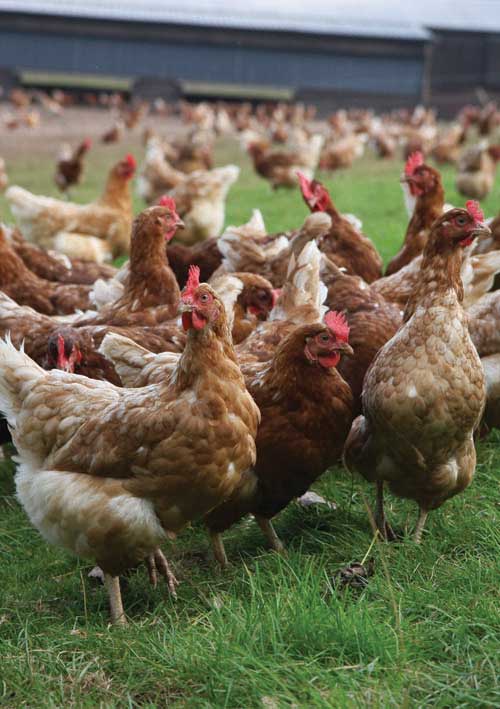
The free range poultry sector is going to be badly affected by the new legislation. The following figures give an indication of the impact of the new NVZ legislation on free range stocking limits:
• Laying hens – 17 weeks and over 310 birds/ha
• Broilers 440 birds/ha
• Turkeys (stags) 125 birds/ha
Once allowances have been made for N losses through housing or storage and for reduced occupancy levels, the whole farm limit effectively reduces the stocking rate for free range hens to 320 birds/ha, based on the assumption that all birds range all of the time. Whilst Defra’s supporting documentation is not specific, it is my understanding that it should be assumed that 80% of manure is deposited within the buildings with the remaining 20% deposited directly to land. This implies an overall maximum stocking density of 1,600 hens/ha, well below the EU limit of 2,500 hens/ha and the recently increased Lion Code limit of 2,000 birds/ha.
For those free range egg producers celebrating the recent Lion Code increase in stocking limits and eagerly awaiting changes to the RSPCA Freedom Food stocking limits, there now needs to be a tempering of those celebrations by producers with limited land availability. Organic producers will not be affected but other farmers stocking at EU levels will have to make changes.
In addition to reduced stocking levels, compliance with legislation means that all manure from buildings will need to be spread on additional land, keeping manure applications below the 170kg N/ha per annum limit. If insufficient land is available on-farm, surplus manure can be exported to other land. Records of manure exports and receiving land have to be kept to for cross compliance and receiving farms will also need to keep comprehensive records. Manure storage problems may also arise with slurry and poultry manure applications being prohibited for 3-5 months of the year, according to soil type and cropping.
For some time the Government has been under pressure from the EU to get to grips with high nitrate levels and as agriculture is seen as a significant contributor, it should have been evident to us that farmers were going to be heavily affected by this new legislation. Jane Kennedy MP, Minister for Farming and the Environment, accepts that "the regulations are challenging and there is a lot of concern within the industry about the extension of the NVZs".
The key issues of the new legislation are listed, however, for poultry farmers it is the Livestock Manure N Farm limit which is likely to cause most problems. This has seen a reduction from the current 250kg total organic N/ha to 170kg total organic N/ha per annum (including manure from grazing animals).
Planning
Following the changes to the Lion Code, many producers were looking forward to increasing farm productivity and profitability. Plans to submit planning applications for more sheds were being considered. However, all of these expansions may need to be put on hold if land availability is limited.
All planning applications have to comply with government legislation, and the Nitrate Pollution Prevention Regulations will have a significant bearing on agricultural planning applications, from agricultural buildings to agricultural dwellings, both temporary and permanent.
Be prepared and ensure that applications are well supported with documentation demonstrating a comprehensive manure management programme with specific contracts relating to the land application of manure. Consultants acting on behalf of the Local Planning Authorities will be looking in depth at proposed stocking rates and land availability.
You will need to show that your holding meets stocking limits and that arrangements are in place to reallocate excess manure to alternative sites.
Help and Information
Technical queries helpine on 0845 345 1302 (Monday-Friday, 7am-7pm until 31 March 2009). Calls charged at the local rate. Information events are being organised throughout NVZs in England details from the helpline and at www.crosscompliance.org.uk/cms/nvz
Software tools to provide help with some of the calculations required under the new rules are available free of charge from www.planet4farmers.co.uk or by phoning 08456 023 864.
Reading Agricultural Consultants for planning and farm management advice Tel: 01235 851515 jill.scrivener@readingagricultural.co.uk




