




A changing climate ahead for farmers
Farmers should not wait for the government to tell them what to do about climate change.
That was the message given to farmers at the South of England Agricultural Society's annual Autumn Farming Conference by environmental expert Professor Philip Stott.
Professor Stott, a regular panellist on BBC Radio 4's 'Home Planet', addressed the audience of more than 200 at the South of England Centre, Ardingly, on Tuesday, 13 November.
He criticised the government for giving vague information regarding climate change and lack of guidance to farmers.
"They say there will be a temperature change of between –2 to +8 degrees centigrade – how useful is that when planning what crops to change? You will have to make choices about what to do with your own individual farms because no one is going to do tell you," he said.
Professor Stott said farmers had been adapting to climate change for 5000 years and were best aware of the problems and how to tackle them.
"Policies are being made by young geniuses who have absolutely no idea of working on the ground. For Defra to suggest that the British public should stop drinking fresh milk and switch to UHT to cut refrigeration emissions is absolute spectacular madness".
The government, he said, was looking at the issue of climate change from the wrong perspective. There was not a need to try and stop it, but to deal with it and adapt.
"If climate were not changing it would be the first time in 4.6bn years. Humans do have an effect but I can tell you there is nothing we can do in the Britain, without exception, that will have any effect on climate change whatsoever.
"We are just a small island and by 2020 we will only be using 1% of the world's energy. What we need to ask is can humans manage climate change? What climate are we going to predict? Successful management lies in predictability and outcomes".
Professor Stott urged farmers to prepare for an increased demand for food and embrace all technologies to meet these needs.
"The government will come to you and suddenly expect to protect food security. In 1947, following WW2 there was a change in food policy and we're coming to that point again," he said.
"You need to be ready. We need GM crops within organic systems. I'm sick of hearing 'what's better organic or not?' – we need them all as the population is going to explode".
Peter Kendall, president of the National Farmers Union, echoed Professor Stott's remarks, but said the changing climate offered farmers a 'fantastic opportunity'.
"It's a chance to get on the front foot and change the perception that farmers in this country have been a pain in the back side for the last 20 years," he said.
Farm Sunday, which saw 150,000 farms open to the public last June, successfully raised awareness, said Mr Kendall. He added that the Red Tractor accreditation scheme was also helping to improve the reputation of UK produce.
"We must spend more time spreading the message and make sure the consumer stays with us and demands British in the future" he said.
The conference was sponsored by Lloyds TSB Agriculture and arranged by Jeremy Burdett and the South of England Agricultural Society.
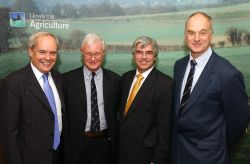
Caption: Left to right - David Allam, chairman, South of England Agricultural Society; Professor Philip Stott; Brian Gilbert, Regional agricultural manager Lloyds TSB; and Jeremy Burdett, conference organiser.




