




Close look at costs reveals free range loss
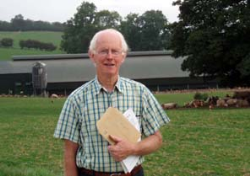
Former NFU president Sir Simon Gourlay is a man who treats his farm as a business and expects it to pay.
That was one of the reasons that he got into free range back in 1999, a move that helped his business diversify away from total reliance on subsidised sectors of British agriculture.
At the time Maryvale farm, near Knighton in the Welsh Borders, was growing 100 ha of cereals along with a further 172 ha of grass supporting a beef and sheep enterprise. Now the farm is grass-only and the cereals and beef have gone leaving just sheep to share the pasture with the free range hens, which have now grown to 22,000 in number.
"Free range complimented what we were doing on the farm and we had a ready-made poultry manageress in the shape of Rose Morris who is the wife of one of our farm workers," says BFREPA member Sir Simon, pictured above.
And while he describes the venture into free range as having been a success, a close look at the books has revealed that the enterprise is no longer profitable. All costs incurred by the three flocks come under close scrutiny—something Sir Simon believes many producers don't do.
"It's all too easy not to cost everything out fully which can leave producers under the impression that they are making money when in fact they are not.
"We include a realistic figure for depreciation because at around £22 a bird place—excluding land—the unit involves a substantial investment," he told the Ranger.
"And we haven't finished paying for it yet so we are still carrying a finance charge and with no family labour to rely on our wage bill is significant."
72-years old Sir Simon—who describes himself as semi-retired—estimates that when all costs are accounted for, his hens are now losing money. As revealed in last month's Ranger, the latest costings produced by BFREPA puts the average loss on free range farms at nearly one pence for every dozen eggs produced.
But Sir Simon accepts that there are those farmers who may still see free range as an attractive proposition.
"If a dairy farmer has a herd of cows and maybe some land to sell and invests the money in free range and runs the unit on family labour, then the enterprise may appear profitable. But this is no basis for a business venture."
With flocks at Maryvale Farm performing to breed target, the need to get the enterprise back into profit has led Sir Simon to sit down with a consultant and see if production costs can be trimmed. The conclusion was that there were few savings to be made.
"Feed is the biggest single cost and represents nearly half the total production costs. But our feed use is efficient and it is difficult to make any savings there.
"Labour represents 16 per cent of costs but again it is not an area where savings can be made easily. We already have farm packers installed so there is no room for reducing egg collecting costs."
At only one per cent of total costs, the farm's vet bill is far from excessive, leaving the consultant to conclude that the only area where savings could possibly be made was in repairs and maintenance.
"Our aim at turnaround has always been to try and ensure the units are in the same condition as when new and at times that has led to spending money that could have been avoided," explained Sir Simon.
"But it can be false economy to make such cut backs. For instance, we've just replaced an auger system that was still operating but had been proving problematic. If it had failed during the life of the new flock, what would the cost have been then?"
While any business needs to keep a close control on costs, Sir Simon knows that the real answer to the free range sector's present financial troubles lies not in cost-cutting but in a substantial increase in the price producers are paid for their eggs.
"We've suffered falling egg prices for over two years now while at the same time
had to absorb rising production costs.
"Wages, fuel, electric, insurance—the list is endless—have all increased during that period. And we now face the prospect of having to pay significantly more for feed this winter."
So how does Sir Simon—who led the nation's farmers from 1986 to 1991—believe the required increase in producer price can be achieved? With supermarket pricing strategies threatening to take the once-profitable free range sector down a route only too familiar to hard-hit dairy farmers, Sir Simon discounts the idea of direct action similar to that seen in the dairy sector.
"It hasn't worked for milk producers and such action is unlikely to succeed for free range producers.
"The answer lies in convincing retailers that unless profitability is restored then the predicted growth in free range will not come from UK production. Producers need to see a return on their investment and—unless they are desperate for something to do—anyone who has done their sums is unlikely to invest in free range in the present climate. If that leads to a shortage of eggs then everyone in the supply chain—including retailers—stands to lose out."
As Sir Simon heads towards full retirement (his eldest son Alistair is taking over the running of the farm) he hopes very much that free range egg production remains an integral part of the family business—but it will have to pay its way.
"While it may be possible to ride out any short-term loss of profitability, it is not a position that is sustainable in the longer term," he says.




