




Do traditional breeds lay better eggs?
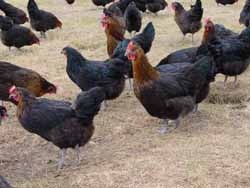
Old breeds of hen are increasingly making a comeback to supply niche free range markets. But are their eggs really any different from those produced by modern hybrids? New light has been thrown on the question by research jointly carried out by the Roslin Institute and University of Glasgow.
The researchers have revealed that one of the regular claims made for the old breeds—that they lay eggs with stronger shells—does not hold water. Commercial breed eggshells are just as strong. But the sacrifice made to achieve this is that the hybrid hens have weaker bones. The team have also shown that the bigger eggs produced by the modern layer contains only extra albumen, which is largely water.
The project involved comparing the eggs of a dozen commercial breeds with those of 13 traditional hen varieties including Araucana, Buff Orpington, Light Sussex, and Jersey Giant.
For the project the birds, up to 16 of each strain, were all obtained as day olds, kept in 25 similar pens and given identical feed. But the project suffered losses due to cannibalism—in both the commercial and the traditional breeds—and at 30 weeks the birds were housed individually in cages.
The eggs were collected daily and at 55 weeks one egg from each bird was tested for shell strength, shell colour and weight of yolk and albumen.
The commercial breeds obviously came into lay earlier and out-laid the traditionals by over 30% in the in the earlier weeks and by almost double in the later weeks. At 55 weeks the commercial eggs were 10g heavier but this was almost entirely made up of extra albumen. In fact the yolk weight of the traditional breeds was almost a gram heavier but the albumen in the commercial eggs reached over 37g compared to just 30g in the old breed eggs.
"As breeding companies select for higher egg weight they appear to have selected for increased albumen weight and to have decreased the energy content of the egg," says the research team. "If the proportion of yolk is commercially important to egg processors, for example, then direct selection on yolk proportion will be necessary."
The traditional breeds produced a darker yolk (a Roche score of 8.6 compared to 7.3) but there was wide variation between yolk colour within both the commercials and the traditionals. This leads the researchers to believe that there may be an important genetic link to yolk colour that is independent of productivity.
The commercials had higher Haugh unit score (76.8 compared to 74.2). There was no notable difference in blood spots or other inclusions.
While measurements showed that "modern" eggs are longer and wider than traditional ones they were also able to withstand a marginally heavier load when tested for strength. But the bones of the commercial layers were shown to be weaker.
"The results suggest that the mobilisation of calcium in traditional and commercial lines has similar effects on the bones of both categories," say the researchers, "but problems of bone breakages occur in commercially selected layers because they come into lay earlier and continue at high rates of lay for an extended period."
But in their report, published in the journal British Poultry Science, the researchers have a warning for the industry. They point out that shell strength in commercial flocks declines after 70 weeks and osteoporosis increases with age.
"The trade off between bone structural integrity and eggshell quality is not inexhaustible," says the report. "The results of this experiment suggest that by selecting for higher rates of lay and greater persistency whilst maintaining egg quality, breeders have inadvertently predisposed commercial laying stock to bone- related damage over a relatively long period of time."




