




Fendt to use regenerative energy from the region
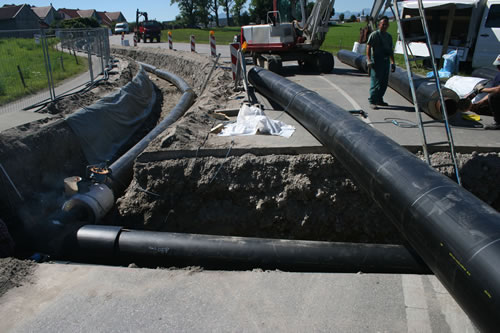
Starting in September, Fendt will heat its entire Marktoberdorf production facilities with hot water from the newly built fodder drying plant near Ruderatshofen. It is located only about three kilometres from the Fendt works. To produce heat, the fodder drying plant burns biomass and wood chips from farmers and suppliers in the region. The fodder drying cooperative provides Fendt with a heating capacity of ten megawatts; hot water reaches the Fendt boiler house with a temperature of 105 degrees Celsius.
Economical, environmentally friendly energy production
"Switching to district heating not only benefits the environment, it also has economical advantages for us," explains Michael Hahner, head of plant maintenance, environment, at Fendt. With annual energy expenditures of some 800,000 euros, an economical and cost-effective solution for providing Fendt with energy is of great significance. Using renewable raw materials from the region for producing energy ensures greater independence from the price of crude oil and the price fluctuations and increases that are associated with it. Annual CO2 emissions totalling some 4,100 tonnes can be eliminated completely by using district heating. The wood that is used for producing wood chips comes from the surrounding area. "Afforestation is not necessary, since wood is already available. In this way we can produce energy in a holistic, environmentally friendly manner," explains Uwe Lüpke, head of the project and site supervision engineer at Gammel Engineering.
Biomass from farmers in the region
In the combined fodder drying plant, 44,000 tonnes of wood chips are burned for drying hay as well as producing heat and electricity. That corresponds to about six to eight truckloads per day that the Futtertrocknungsgenossenschaft Ruderratshofen eG purchases from farmers, foresters and suppliers from the surrounding area. "It is a positive side effect that we can also make a contribution to the development of our region by switching to district heating," reports Hahner pleased.
Hot water for Fendt
Some 275 m³ of hot water flow to the Fendt works through 2,800 metre long pipes. "We require a high water temperature of 105 degrees Celsius for our painting and washing facilities," explains Hahner.
The great advantage for the energy partners in Ruderatshofen and Marktoberdorf is the short distance between the drying plant and the Fendt works; only small temperature losses are to be expected on the way. Fendt returns the water back into the circuit at a temperature of about 70 degrees Celsius.
Fendt as bulk purchaser of regenerative energy
The cooperative, Futtertrocknungsgenossenschaft Ruderatshofen eG, came up with the idea to supply Fendt with ecological district heating as a bulk purchaser in June 2007. After carrying out initial talks and investigating the technical requirements, it quickly became clear that nothing stood in the way of an agreement. "We found a reliable partner in Fendt, and that is what set the ball rolling for this project," reports Karl Engert, Managing Director of the Futtertrocknungsgenossenschaft Ruderatshofen eG. The pipeline from the drying plant to Fendt was built for 1.7 million euros. Fendt invested 150,000 euros in the modifications required for using the boiler house with district heating. "It was very important for us to split the pipe system into two circuits so that we can use gas or heating oil in emergencies. We had to carry out the modifications during the three-week company holidays – a great challenge, but we succeeded," confirms Hahner.
Grand opening of district heating network
The heat from the fodder drying plant will be delivered starting in September. On August 31th Fendt and the fodder drying cooperative celebrated the opening of the district heating network. Peter J. Paffen, Vice President Sales and Marketing Fendt EAME, and Franz Otto Eberle, Chairman of the fodder drying plant Ruderatshofen made impressive speeches.
The plant has been drying fodder since May and producing electricity since August of this year. The district heating grid to Fendt is the cornerstone for an ecological energy supply in the region.




