




Four Estates Chosen to Pilot North East Rural Estates Framework
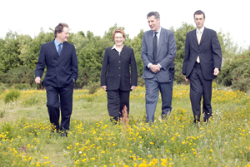
Caption: L ¡V R Angus Collingwood ¡V Cameron, North East Director CLA - Tom Warburton, Head of Regeneration, One NorthEast - Franics Rowe, Rural Manager, One North East and David Fursdon, CLA National President
Four rural estates have been chosen to pilot a unique project that will improve the understanding of the issues facing rural estates today and help regenerate rural settlements.
The North East Rural Estates Framework Pilot aims to help change the way the public sector works with estates by seeking to provide more flexible funding and business support arrangements.
The four estates, Belsay, Mortham, Meldon Park and Lambton, will now begin work to identify their individual needs and access a bespoke package of assistance to address their requirements.
The 12-month project is led by One NorthEast, and the Country Land and Business Association (CLA). It has a steering group chaired by Sir Hugh Blackett, the man behind the award-winning redevelopment of Matfen Hall in Northumberland.
The Pilot, which is being watched closely by other regions anxious to revitalise their rural economies, aims to provide a demand-led solution whereby estates would be able to approach a single contact through which all business support in the region would be channelled.
The Pilot will also look to establish a much better evidence base in order to provide rural estates with a strong platform to influence regional and national decision makers and put a case to government for improved public support.
Frances Rowe, Rural Manager at One NorthEast said: ¡§Estates make a significant contribution to the rural economy. They also play a role in supporting their local community. The North East Rural Estate Framework Pilot will improve our understanding of and ability to support estates in fulfilling both these roles.¡¨
David Fursdon, CLA National President, added ¡§This is a very exciting initiative, which has been created here in the North East. It recognises the role that private land holdings can play in the local community and economy, as well as their role in delivering public policy and public goods. We welcome the intervention of ONE Northeast, and will do everything that we can to maximise the benefits across the Region and beyond.¡¨
North East Rural Estates Framework Steering Group Chairman, Sir Hugh Blackett, said; ¡§This is an exciting opportunity for rural estates in the North East. The Pilot will offer estates taking part the chance to receive a comprehensive package of support.
¡§It will also give them a real say in shaping the way support and funding are offered to rural estates in the future.¡¨
The Pilot follows on from a study commissioned in 2004 to consider the role that privately owned rural estates play within the rural economy and how they could be given better support in the future to increase their impact. The study showed the need to increase engagement between estates and relevant areas of the public sector, with the main findings indicating:
„X Estates have traditionally provided a wide range of public benefits that include; the provision and maintenance of housing for estate employees and others, often at below market rates, upkeep of community buildings and ¡§public¡¨ spaces such as greens and parks, maintenance of water supplies for housing and businesses on the estate, marketing for estate businesses (in-house and tenants) on an estate-wide basis.
„X Currently, while funding is available for individual projects, it appears very little public support goes to the estate as a whole. It is normally only available to purchase specific benefits such as environmental improvements on a farm or an improved community facility.
„X As a result, estates fall outside conventional policy structures and are forced to apply for support through one of the estate¡¦s businesses or by forming a development trust or similar community enterprise.
The North East has England¡¦s highest concentration of rural estates, with an estimated 300 being of more than 1,000 acres in size. Thousands of people in their attached communities depend on estates for work, housing and other social benefits.




