




Gapeworms hit free range flocks
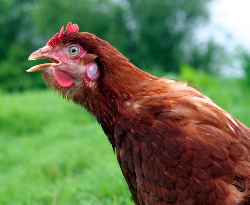
While gamekeepers are constantly on the lookout for an attack of gapeworms in pheasants and partridges being reared for commercial shoots, it is a disease problem that is considered rare in chickens.
But westcountry poultry vet Alan Beynon has recently diagnosed the parasite in free range laying birds.
The gapeworm (Syngamus trachea) is a round red worm that attaches to the trachea of birds and causes the disease referred to as 'gapes', so-called because of the open-mouthed breathing characteristics associated with infected birds as illustrated above. Heavily infected birds produce a grunting sound and because the worms will eventually block the trachea, infection can lead to suffocation.
Male and female gapeworms are in a form of permanent copulation and the eggs they produce are coughed up into the bird's throat where most of them are swallowed and passed out with the faeces, although some may be expelled directly via the beak or nostrils. Sometimes whole worms are disgorged via the beak.
The lifecycle of the worm starts with the miniscule eggs which are spread about the vicinity of infected birds. Within eight to 14 days the eggs embryonate and are infective when eaten by other birds. The resulting larvae then migrate from the intestine to the trachea and lungs.
But the eggs can also be picked up by earthworms, slugs and snails which provide an intermediate host. Gapeworm larvae can remain viable for over four years in earthworms, and around a year in slugs and snails, meaning land can still be infective long after it has been free from poultry.
As well as attending to poultry, vet Alan Beynon specialises in game bird health and is therefore no stranger to gapeworms, although until recently he had only ever seen one case in chickens.
"This last month I've seen three outbreaks in free range laying flocks, all in the same locality," reports Mr Beynon.
"The three farms involved all border a very large commercial shoot so we have to suspect this is the original source of infection, although we cannot be sure how it was transmitted to the free range flocks."
Although it is possible that the gapeworm eggs could have been shed by pheasants and then picked up by the poultry, the vet believes it is equally likely that rooks or crows have played a part in spreading the infection.
"In the past I've opened up shot specimens of these birds and they've been full of gapeworms so it is quite possible that these act as the vector."
All three flocks recovered following treatment with the wormer Flubenvet, although this was not before the worst affected flock had dropped to around 65 per cent production at 35 weeks, and suffered significant mortality.
"This just underlines once again the need to worm free range flocks on a regular basis," said Mr Beynon.




