




Integrate fungicides in brassicas
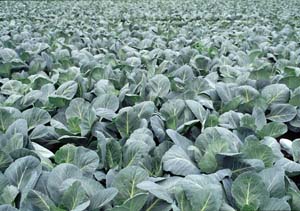
With ever increasing quality demands, brassica growers need to keep a close eye on diseases that reduce quality and be prepared to use a robust fungicide programme, where necessary. As disease pressure usually warrants a number of fungicides over a period of time, they must also integrate products for their optimum performance and as a way of minimising resistance. A Lincolnshire-based agronomist, Mike Leatherland sees Signum as one fungicide that offers good protection against White blister, Dark leaf spot (Alternaria) and Ring spot and that can also be usefully integrated into an effective disease prevention programme.
Advising brassica growers in Lincolnshire for UAP, Mike Leatherland says that it has been a quiet Summer for diseases, despite the high rainfall. "Up until recently brassica diseases were not a big issue, but in the last few weeks they have shot up the agenda. In particular White blister (Albugo candida), which spoils yield and quality of cauliflowers, cabbages and Brussels sprouts, has become much more widespread. Usually this disease is tackled with the curative fungicide metalaxyl in its various forms, but I am concerned that we have relied too heavily on this active ingredient for too many years and for too many applications. We need to actively integrate an anti-resistance strategy to prolong the effectiveness of metalaxyl. One way of doing this is to incorporate strobilurin combinations such as Signum into the programme as protectant treatments."
Ring spot and Alternaria control has also relied too heavily on curative triazoles for a number of years and Mike indicates that their use needs to be integrated with strobilurin fungicides in a responsible way.
Mike Leatherland thought that when Signum, one of the first strobilurin containing fungicides to be used in brassicas, was launched a few years ago it was a significant new product and since then he has used it in a preventative way in many vegetable crops.
"Signum is one of a number of materials with an important role to play in reducing the impact of diseases in recommended brassica crops. As a protectant, Signum is useful early on in the crops' life for broad-spectrum disease prevention as well as for its plant health benefits. It also is a crop-safe fungicide, unlike some triazoles. These plant health benefits also come in later in the season, where greening of the foliage help crops thrive as they approach the Winter. Signum's short harvest interval of 14 days is also helpful to some growers on a rotational harvesting programme. Other materials have longer harvest intervals and this makes them less flexible to use closer to harvest time," points out Mike.
Signum has label recommendations in Brussels sprouts, cabbages and cauliflowers for the prevention of Dark leaf spot (Alternaria) and White blister plus useful control of Ring spot. Both active ingredients in the product, boscalid and pyraclostrobin, also have activity on Powdery mildew. There are also a number of SOLAs*, including protected and outdoor leafy brassica crops grown for baby leaf production, outdoor and protected Chinese cabbage, outdoor collards including spring greens and outdoor kale.
"In addition to effective disease control, Signum has been shown to play a key role in boosting the crops' own defence mechanisms as well as reducing the effects of stress and aiding the plant stability to maximise nitrogen usage. In research a pre-treatment of plants with a foliar spray of pyraclostrobin significantly reduced the severity of viruses and bacterial diseases including Xanthomonas - an effect we believe is associated with triggering the plants' own host-defence mechanisms. The plant appears to be primed by pyraclostrobin so that when the pathogens attack, defence proteins within the plant are produced more quickly, allowing the plant to fight off the invading pathogen," explains Matthew Blaken, BASF Field Vegetable Manager.
"The direct and indirect effects of the two fungicide components in Signum add up to a powerful combination which will lead to top yields and quality brassicas produce that the market is looking for," says Matthew.




