




New data shows good energy levels in winter grass
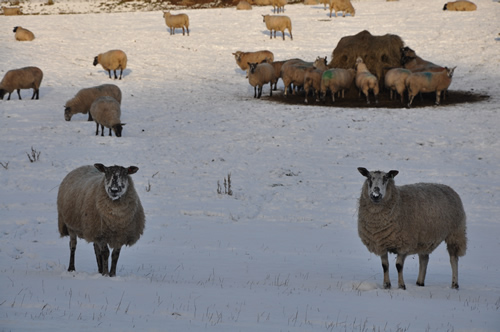
Winter grass emerging from a blanket of snow and frost does so with a surprisingly high ME content and the phenomenon can help sheep farmers delay compound feeding and conserve meagre, yet highly valuable forage stocks for later in the season.
Rumenco has just released new forage analysis data based on samples of grass collected around the country in January (see table). Grass was collected from eight sites, all of which had suffered from prolonged snow cover during December and early January.
"We expected the grass to be of extremely low quality, but whilst dry matters and protein levels were notably reduced, energy levels, paradoxically, were consistently high," reports Rumenco technical manager David Thornton.
Average protein level was 16.8%, yet the mean energy level was 12.4MJ/Kg DM with sugars a reasonably healthy 14.4% – plenty enough to sustain a mid term, twin-bearing ewe provided she has access to Rumevite feed blocks to encourage foraging behaviour. The dry matters are low, but this is not a major issue in mid-pregnancy before foetuses begin their rapid growth, he points out.
"The results surprised us, but it has been suggested that the snow may have protected the grass from wind chill. It has also been shown that light passes through snow and, indeed, may even be magnified when it moves through the ice crystals. Consequently, the grass will continue photosynthesising well, even though it is covered by a white blanket."
This latest data suggest many sheep producers will have better than expected nutrition in their late winter pastures and may even be able to delay the introduction of expensive compounds. With conserved forage values also at an all-time high and stocks dwindling fast, the news is a welcome boost for producers struggling with the consequences of such a harsh winter.
"Many ewes are in quite a fit condition, having benefited from having access to conserved forages and feed blocks while snow lay on the ground. This means it should be possible to delay cake feeding on many units, even if forage stocks are short. Rumevite feed blocks provide all the supplemental nutrition the ewes need, and encourage the sheep to make the most of the winter grass that is available to them," David Thornton says.
However, Mr Thornton cautions against grazing winter pastures too hard for too long at the end of the season, as this can delay spring grass growth needed for lactating ewes and lambs.
Analysis of nationwide grass samples (January 2011)
Location DM% CP% ME Mj/kgDM D value Sugars%
Carmarthen 13.1 16.9 12.8 80 15.3
Powys 15.3 16.5 12.2 76 14.4
Devon 11.7 19.3 12.9 81 16.6
Gloucestershire 10.6 16.1 12.5 78 13.7
Cumbria 18.8 12.5 11.9 74 7.1
Yorkshire 22.3 17.2 11.6 72 16.5
Borders 15.9 18.0 12.5 78 15.2
Perthshire 12.5 18.6 13.4 83 16.6
_________________________________________________________________
Mean 15.0 16.8 12.4 77 14.4
(All data on a DM basis)




