




OSR crops require late Phoma protection
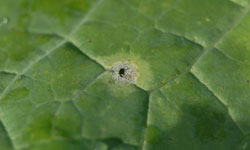
Growers must remain vigilant for late Phoma lesions breaking out on oilseed rape leaves, and be ready to treat with Plover before infection reaches the stem.
Oilseed rape crops remain vulnerable to late season Phoma attacks. Cold weather will slow disease development, but growers need to treat with Plover before infection spreads on smaller crops.
Oilseed rape growers with crops that have not yet completely covered the soil surface need to be extra vigilant for late Phoma infection this season. A cold spell now will slow development, but infection can still reach stems and cause early plant death as soon as the weather warms up again. Crops in the south and west are reported showing high signs of Phoma infection.
Peter Gladders of ADAS highlights crops which were slow to be treated in the autumn are already seeing plants dying as a result of early Phoma infection. "It's too late to do anything about early infection that has reached the stem, but smaller plants and susceptible varieties are still more vulnerable to late infection," he warns.
Smaller crops, currently with a low Green Area Index, will not require a spring growth regulatory fungicide, so Phoma control remains important now. "Growers' priority in early spring will be getting on with nitrogen and sulphur, to get thin crops thickened up and growing strongly to reach their potential," adds Dr Gladders.
Syngenta Technical Manager, Beth Hall, advises cold weather will not kill Phoma lesions on the crops leaves, but it will slow movement of infection down the leaf. "There's still the chance for Plover application to control late Phoma infections before the disease reaches the stem and causes cankers.
"With more open crop canopies plants tend to hang on to older leaves for longer, so there is a greater risk of established Phoma infection spreading; thick crops shade out the infected older leaves, which die back and drop off.
"If new lesions are identified on any of the upper leaves, a Plover application can still prevent infection developing on the stems and causing yield loss." Mrs Hall highlights it is important not to delay application if new lesions are identified, since infection could spread quickly on warm days. Plover application can be made right up to stem extension
Mrs Hall believes stronger crop canopies in the spring could be the norm in future years. "With growers looking to manage crop green leaf area more effectively, the combination of Plover (difenoconazole) and plant growth regulators (PGR) in the spring will be an essential tool for higher yields," she adds.




