




Research helping to conserve Wales’ most endangered animal
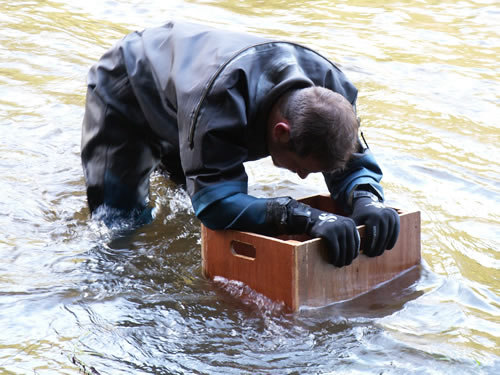
A Swansea University student is researching one of Wales’ most endangered and enigmatic aquatic species, the freshwater pearl mussel.
Gethin Rhys Thomas (25) from Ammanford is starting his third year as a PhD student at the University’s School of the Environment and Society, where he is working under the supervision of Dr Carlos Garcia de Leaniz, a Senior Lecturer in the Department of Pure and Applied Ecology.
Gethin said: "Surprisingly few people are aware that there are freshwater pearl mussels in Welsh rivers, or that they are possibly the most endangered aquatic organisms anywhere in the world".
Freshwater pearl mussels can live for up to 200 years, and have unique parasitic lifecycles relying on salmonid hosts – such as brown trout and salmon - for their survival: the juvenile mussels attach to the gills of salmonids, where they develop for several months until they fall off to the river bed and begin feeding by themselves.
Freshwater mussels are critically endangered, yet they are considered "flagship" species as they play a key role in the recycling of nutrients in rivers. They are seen as a good indicator species, and their decline can have important knock-on effects on the entire river ecosystem.
Freshwater mussels used to be widespread across Europe, but have suffered a 95% decline over the last few decades, mainly as a result of habitat loss, pollution, illegal pearl fishing, and river engineering.
Studies in some Welsh rivers show that few or no mussels have been able to reproduce over the last 30 years, resulting in ageing populations. Salmonids have also declined, making it even more difficult for mussels to reach maturity and reproduce.
Gethin said "Once, most salmon rivers would have had freshwater pearl mussels. Now, there are only half a dozen mussel populations in Wales, and they’re not reproducing – which has obvious consequences for the survival of the species.
Gethin has recently received a grant from Cymdeithas Edward Llwyd, the Welsh Naturalist’s Society, to investigate host specificity in the mussels in collaboration with the Environment Agency Wales. In particular, he is focusing on identifying those traits that make salmonids become receptive to hosting freshwater mussels as part of a captive breeding programme.
He said: "Our research is important for the conservation of freshwater mussels, particularly for Welsh rivers, as it is helping us understand critical bottlenecks and to develop better conservation strategies. It also raises awareness of this critically endangered species"




