




Robust black-grass control still required - though scope to improve cost-effectiveness
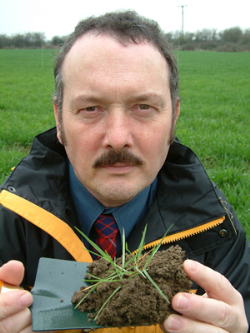
DON'T skimp on black-grass control this autumn - even with the cushion of single farm payments - wheat growers are being advised.
Left untreated, even an average population could slice £150/ha off crop income. However, there is scope to improve the cost-effectiveness of control - by tackling the weed hard in autumn, rather than leaving until spring.
Those are the key messages emerging from leading technical experts as growers begin considering autumn inputs - in their first full season of farming post Mid Term Review.
John Cussans, weed ecologist at Rothamsted Research, has conducted a DEFRA-funded study to assess whether it is possible to adopt a 'wait and see what emerges' policy before deciding whether to tackle black-grass - or whether it is necessary to follow a pre-planned, or prophylactic, approach. While there are some weed species suitable for the former, he says black-grass definitely isn't one.
"Although this is okay for a great raft of weeds, there are three or four species where you can't do this," he explains. "You have to have effective control in place if there's a history in that field. It's not just about crop yield loss - it's about how numbers increase through subsequent crops.
Non prophylactic control is not the way to go."
Moreover, Mr Cussans says latest findings show a yield loss of 5% from every 100 black-grass heads per square metre left in the crop.
But while this may not sound high, a key problem with black-grass is the high populations often encountered Iain Hamilton, Syngenta technical manager, points out.
Left untreated, even average black-grass infestations of 450 heads per sq metre have been recorded in Syngenta trials over the last four seasons, he says. That is equivalent to £150/ha of lost income from a 9 t/ha wheat crop with grain at £65/t.
"Clearly farmers are questioning input costs. And grass weed control is no exception," explains Mr Hamilton. "So with these sorts of losses at stake, the herbicide programmes growers choose mustn't only do a good job, but be cost-effective as well.
"A key area for improvement is with time of control. There were many occasions last year, for instance, where black-grass herbicides weren't applied until spring. That effectively loses growers money - since it's been shown clearly that spring removal results in 16% less yield compared with autumn control.
"My advice with black-grass is definitely to remove it early - and use a suitably robust treatment. Hawk-based mixtures fit ideally in this role, because they allow growers to target the weed while still at its most vulnerable 1-2 leaf stage.
"Where growers have been using a mainly soil-acting early spray of isoproturon + trifluralin, because the performance of this mix can be affected by soil conditions and weather, it can leave black-grass survivors which need cleaning up later.
"Even if 70% black-grass control is achieved from an early residual spray, that could still cause an 8% yield loss if final control isn't carried out until spring. By comparison, using a Hawk + isoproturon mix at this early timing has given higher levels of control in trials - and only required a follow-up treatment half as many times."
Alternatively, if looking to use newer sulfonyl urea chemistry to tackle black-grass early, Mr Hamilton says mixing Hawk with meso/iodosulfuron has performed well in trials.
As well as producing good control, he says herbicide programmes must also be sustainable - so that resistance doesn't build-up by using the same herbicides year after year.
Dr David Ellerton, technical director of the Procam Group, agrees it is important to maintain the sustainability of currently-available herbicides by using them responsibly. Also, that it is important to get a robust herbicide treatment on early in black-grass situations - even if a follow-up treatment is planned for later.
"My feeling is do something early but make it robust. Go as early as possible - i.e. at the one leaf stage rather than the three leaf stage," he adds. "If you wait until spring you are putting huge pressure on and are likely to select for resistance." It is in the early post-emergence timing that he too believes Hawk fits.
Also, consider which herbicides were used last year and use ones with a different mode of action to manage resistance, he advises, rather than putting emphasis on the same ones.




