




Student wins national recognition for work in free range
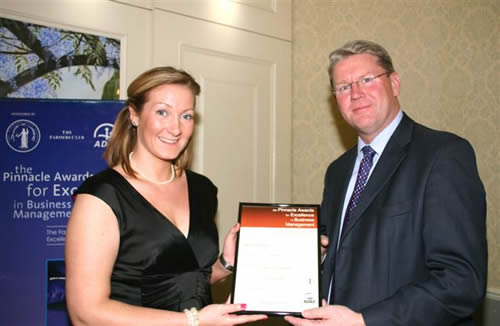
A student has won national recognition for her work in helping new producers into the free range egg industry.
Jill Brown, a student at Scottish Agricultural College (SAC) Aberdeen, received a bronze award in this year’s Pinnacle Awards for devloping a guide for farmers thinking of becoming free range producers. The awards are run jointly by ADAS and The Farmers Club, and are designed to recognise agricultural students who devise innovative solutions to real business problems. Jill was up against other students from all over the UK and, although she was beaten to the top prize, she said she was very proud to have received bronze.
"It was an achievement for every student who reached the final stage. I am delighted to have got the bronze," said Jill, who is studying rural business management at SAC Aberdeen after transferring from an agriculture course at the college. She hopes to go into agricultural consultancy after completing her studies.
The work for which Jill received her award was carried out during a 12 week placement with Farmlay Eggs in Aberdeenshire. The placement was intended to give her some experience of agricultural consultancy work. "The idea of the placement was to take on the role of an agricultural consultant and look at how a business might change or improve an area."
Farmlay is the second biggest independent egg producer in Scotland, with 200,000 cage layers and 50,000 free range birds. Additional eggs are sourced through producer partnership contracts with other farmers. Farmlay has been looking to recruit more producers to help fulfil a contract with the supermarket, Morrison, for the whole of Scotland and for other contracts it hopes to win. It needs to increase free range because of retail trends and because conventional cages will be banned in the EU at the beginning of 2012. Jill’s work looked into the economics of producer partnerships and it resulted in the development of a guide to ease the way into free range production for those new to the egg business.
"Farmlay Eggs had invested £1.3 million in its headquarters and packing facilities. They were looking to increase egg production so they were in a position to gain further contracts, but having just put £1.3 million into the headquarters it would have pushed them financially because it costs approximately half a million to put a flock of 12,000 birds in," said Jill. She said the company would be looking at possibly an extra four flocks at a total cost of about £2 million. "It’s quite a good choice to go for producer partnerships rather than that investment."
However, the information Farmlay had for potential new producers was pretty limited at the time, said Jill. "There were just a few sheets on what to do. I produced a guide for the farmer which went from A to Z on what they would need to do to add layers to their unit. That was everything from the choice of pullet, when to order the pullet, what type of pullet to go for, the housing, the availability of the housing, things to consider when you were looking at location," said Jill, who said the guide also covered considerations such as planning permission.
Although the work was done on behalf of Farmlay, she said the guide was also a great benefit to farmers who may have been considering going into eggs. "Although we had to go in as an agricultural consultant for that business, I feel it was the farmer who mainly benefited from having this producer’s guide because it made so much sense to go ahead and do it. Financially, it was a payback period of five years. During the time that included taking a reasonable wage from the layers as well. If the farmer wanted to add the layers to the farm but not be physically involved, he would have the opportunity to employ someone as well. Financially it was a very sound project."
Jill said the guide was designed so that it could be easily understood, whether or not the reader was from an agricultural background. "Most of the producers have not had anything to do with poultry at all. They are arable and beef units that have come on board. The guide is used now for producers who are interested."
The benefit for Farmlay, she said, was that the investment in new free range units would be made by individual producers rather than the company. It would have secured the extra eggs it needed through contracts with the producers and without having to make a huge financial commitment to building its own additional units.
"I looked at the best financial way forward for Farmlay to increase production. They already have the facilities. The facilities (packing) they have were upgraded two years ago and I know they are not used to maximum capacity. They have possibilities to increase the egg numbers and still be able to handle it." She said the best approach, rather than investing £2 to £3 million on just four units of their own, was to take on as many new producers as they wanted, secure the supply of eggs they needed and not be responsible for the investment.
"Maybe that sounds unfair to the producer, but looking at it from the producer’s side I feel that the project probably benefits the producer more than Farmlay Eggs. They have this whole package there that explains to them what to do, how to go about doing it and in what order. Although the investment is high, the payback is really quick compared to a beef unit or sheep unit or pig unit or arable unit. The risks are lower, if you look at it that way." She said it would be very difficult to attain the profitability available to an egg producer in another type of agricultural production.
Jill had no previous experience of the poultry sector before doing her placement at Farmlay Eggs. Her grandfather had beef and sheep in Caithness, but eggs were completely new to Jill as a farming enterprise. However, she clearly made an impression on the owners of Farmlay, Robert and Ethel Chapman.
"Jill is a real bright spark. Whatever she does in life, she will do well," said Ethel, who said the company had since expanded on Jill’s work because it had been successful. "We have done a little bit within what she had done but she very much laid the ground basis of what we are doing now."
She said the work that Jill had done had helped Farmlay in approaching potential new customers. "When anybody came to us as well we had the information there and we could present them with the initial thing. If they were more keen then we obviously had to go into more detail, but with the initial contact quite a bit of the work that Jill was doing was helpful to us."
The Pinnacle Awards are now in their twelfth year. The final award went to George Hood, a final year student at Reading University, who developed a business strategy to improve the business prospects of a large mixed farm. All eight finalists were assessed on both the originality of their ideas and on their ability to communicate them. The selection process involved a panel interview and a presentation to other competitors and tutors.
Brian Angell, agricultural and rural advice product leader at ADAS, said, "It’s fantastic to be a part of this - we place a great deal of importance on investing in the UK’s agricultural future, and the finalists, who literally came from Lands End to John O’Groats, should all be extremely proud of themselves. More than anything else, this was about giving something back to the industry, and investing in young agricultural talent."
He said, "It’s crucial that agricultural management tempers creativity with practicality and the ability to communicate ideas with others, including potential investors, industry colleagues, and other industry figures. The awards are designed to test students fully on each of these criteria."
The judging panel




