




Tough new rules on salmonella
For more free range stories or to join the British Free Range Egg Producers association visit www.bfrepa.co.uk
Egg producers face swingeing penalties if salmonella infection is found on their farms.
The prospect of flocks being slaughtered without anything in the way of compensation comes as a result of new rules adopted across Europe aimed at reducing salmonella in laying flocks.
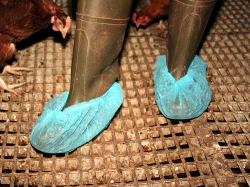
As part of the EU¡¦s zoonoses legislation, starting from January 2008 producers will be required by law to take environmental samples from all buildings housing their flocks. Testing will have to commence when the birds are between 22 and 26 weeks of age and then repeated at intervals of 15 weeks. On each occasion two pairs of boot swabs will have to be submitted.
Once every twelve months an official sample will be taken by the ¡§competent authority¡¨ from one flock on the holding. As well as taking boot swabs, 100 grams of dust will be collected from ¡§prolific sources of dust throughout the house¡¨. If insufficient dust is available, officials will collect 150 grams of faeces or take an extra boot swab sample. Official sampling will be stepped up on farms where salmonella is discovered or has been found in a previous flock.
Initially samples will only be tested for Salmonella enteritidis and Salmonella typhimurium, the two most common salmonellas associated with eggs, while further sub-types are likely to be included in the future.
But for producers the most worrying aspect of the new rules is the consequence of unearthing a positive sample. The Commission intends to ban the sale of eggs at retail level from flocks found to be positive. These eggs will only be allowed to go for processing after they have undergone heat treatment. But there is no guarantee that processors will be willing to take eggs from infected flocks which could leave producers with no other option but to slaughter affected birds with no compensation.
Originally the Commission was expected to introduce the retail sale ban in 2010 but is now considering bringing this date forward to February 2008. Such a move would leave EU countries very little time to bring under control any salmonella problems.
¡§This has very serious implications for the majority of member states,¡¨ says Mark Williams, chief executive of the BEIC which has been heading up the egg industry¡¦s negotiations with Defra on implementation of the regulations into domestic law.
¡§What it means in practice is that producers will have just one flock in which to ensure they do not have salmonella on their holding. If the 2010 date remains in place they would have three flocks, which is more realistic.
¡§We could therefore be faced with a situation of serious market disruption, whereby large numbers of eggs in certain member states will be required to be sent for heat treatment. This will cause a massive shortage on the table market and totally overwhelm the processing market.¡¨
The Commission has stated that its ultimate goal is to see the incidence of salmonella in laying flocks reduced to two per cent or less. Results of a survey recently published showed infection levels across EU farms ranged from nil in some states to as high as 79 per cent in others. In the UK the figure was 11 per cent, eight per cent of which were infected with either enteritidis or typhimurium.
To achieve its goal as quickly as possible the Commission has introduced target figures which aim to ensure rapid progress is made in those countries where the incidence is highest. The target figures for member states, which apply from January 2008, are:
„X A 10 per cent reduction if the prevalence of salmonella in the preceding year was below 10 per cent.
„X A 20 per cent reduction if the prevalence of salmonella in the preceding year was 10-19 per cent.
„X A 30 per cent reduction if the prevalence of salmonella in the preceding year was 20-39 per cent.
„X A 40 per cent reduction if the prevalence of salmonella in the preceding year was 40 per cent or over.
The regulation states that the first target should be achieved in 2008 based on the monitoring in the beginning of that year.
The new rules also require salmonella vaccination of laying flocks from January 2008 in countries where the infection levels are higher than 10 per cent. However, individual farms may be exempt from this requirement if national authorities are satisfied that effective preventative measures are in place or if there has been no evidence of salmonella on the holding during the previous 12 months.
The Commission has stated that it is not in favour of antimicrobials being used to prevent salmonella and therefore should not be part of member states¡¦ national control programmes.




