




Wherever fan noise is a problem, Hydor makes gaining planning consent far easier
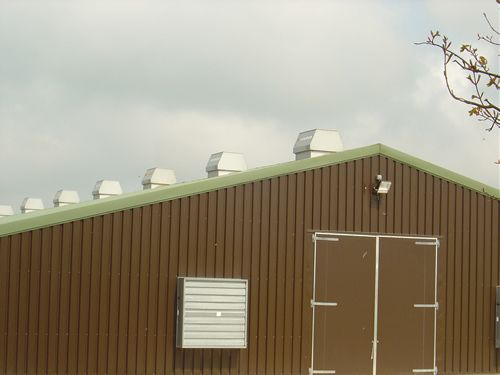
With IPPC Regulations and national and European government requiring reductions in noise levels, local planning officers are now looking very closely at noise emissions from agricultural sites. In particular, they are considering ventilation systems, especially where proposed poultry sites - or extensions to existing sites - are in close proximity to residential dwellings. Meeting the criteria of local planning authorities is therefore becoming increasingly difficult as most standard fans produce similar levels of noise.
During the daytime hours of 7am -11pm, noise levels of 55dBA to 63dBA are generally permitted. At night between the hours of 11pm - 7am, when fewer fans are normally required thanks to the lower external temperatures, this reduces to only 45dBA to 57dBA. To meet just these levels, many models require additional equipment - or a major design change. When planning permission is being sought, even lower noise levels would be preferable and therefore more readily accepted by the relevant authorities.
It is stating the obvious but an important point nonetheless that fan noise is accumulative. The more fans that are in operation, the more noise will be created. As a general rule of thumb, every time the number of operating fans is doubled, the noise level increases by 3dBA. Conversely, every time the distance from the source is doubled, the sound level decreases by 6dBA. But this is based on the assumption that all the fans are at the same point, which in reality will never be the case, as fans are usually spread throughout the length of any animal housing.
However, this is only a simple guide and, in practice, it is better to assume that only 80% of the difference (i.e. 5dBA) is actually obtained. This invariably means that the services of an acoustic engineer are required in gaining the necessary approvals.
Hydor has manufactured various models of its renowned Agri-jet, roof-mounted units for over twenty-five years, to suit differing applications worldwide. Suitable for on-ridge or off-ridge installation, these versatile, high-velocity, jet-extraction units eject the air vertically. Dust and noise are carried upwards to 20metres before being dissipated in the surrounding atmosphere.
Enhanced airflow, created through low back-pressure resistance coupled with high-efficiency fans, helps to minimise operational costs. This can prove vital for many producers in these times of escalating energy prices.
In order to reduce noise levels inline with regulations, Hydor has recently introduced the Hydor Agri-jet ’Silent’. These units have the same proven versatility as the original Agri-jet but with sound levels measured at 3 metres (the standard distance of measurement from source), noise levels of the largest




