




Yellow Peril spots sclerotinia risk for OSR growers
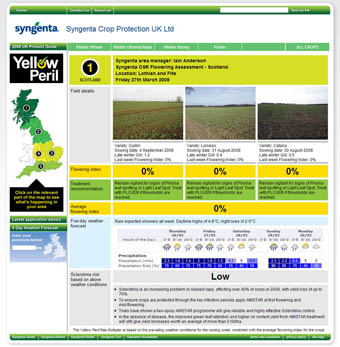
Yellow Peril is a new online sclerotinia risk assessment web site from Syngenta. It will enable oilseed rape growers to visually compare how their crops are faring against others in their area, to help calculate the disease risk. Growers and agronomists can use the Yellow Peril web site free at www.syngenta-crop.co.uk
Launched this week (1 April), Syngenta Area Managers will monitor reference oilseed rape crops across the country throughout the flowering period, to asses the extent and duration of flowering. Coupled with local weather forecasts Yellow Peril will provide a guide to the optimum Amistar spray timing for sclerotinia control.
Syngenta Oilseed Rape Manager, Nick Watson, highlights that with this season’s huge variability between fields, and even within the same field, growers are going to have to treat each crop on its merits to get the best results.
"There does appear to be a direct correlation between the duration of flowering and the level of infection experienced. Prolonged flowering exposes the crop to the risk of sclerotinia infection for longer," he warns. "Yellow Peril will provide a valuable reference guide to what is going on in different regions and help growers’ to assess the risk to their own crops."

In 2006, when the crop flowered for an average five weeks, infection was relatively low; in 2007 the average flowering period was just over six weeks and, although it remained dry throughout the flowering period and was adjudged a low risk season, the actual infection experienced and the crop losses were very high. In the dull, wet season of 2008, flowering went on for well over seven weeks and crops suffered an unprecedented level of infection – with 40% of crops affected and losses estimated at over £20m.
The Yellow Peril web site will include advice on when the reference crops should be sprayed to offer the best possible level of protection through the flowering period.
Trials have shown that where crops are backward or more variable – as is the case with most this year – a two-spray Amistar programme will protect the crop through an extended flowering period and generate significant extra yield and additional margin. The first Amistar applications should be made as the majority of the field is at early flowering, with a second application three to four weeks later when the rest of the crop is coming into flower.
"The initial Yellow Peril crop monitoring has already identified the huge variability between crops this season, as a result of difficult establishment in the autumn, harsh winter weather and excessive pigeon damage," according to Mr Watson. "The effect that this has during the flowering period will be crucial to how growers time their fungicide applications and manage their sclerotinia control."
For further information and gain free access for Yellow Peril growers and agronomists can log on to www.syngenta-crop.co.uk




