




Ants will eat African pests
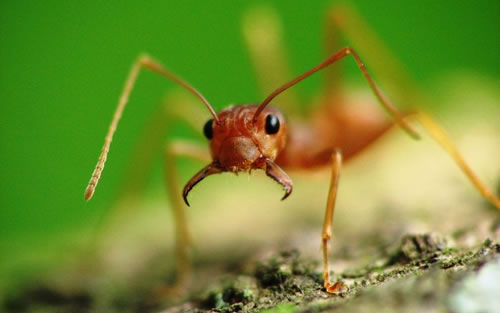
African fruit farmers suffer great economic losses in their mango and cashew orchards due to harmful insects. A new research project will use untraditional pest control: ants will eat the pests.
Every year African farmers suffer great economic losses because their crops are attacked by insects. The pests are traditionally controlled with insecticide but that is an expensive and inefficient solution. Danida has therefore granted 10 mill. kr. to a new project in which ants will be used to control the pests.
Scientists from the Faculty of Agricultural Sciences, Aarhus University, will be participating in the project, which is being led by biologist Mogens Gissel Nielsen from the Faculty of Science. The agricultural scientists will use their extensive knowledge about ants and bees and other insects to establish and manage weaver ant farms.
Previous results show that pests can be controlled effectively and cheaply with the aid of weaver ants.
- We will be investigating how weaver ants reproduce. We will collect semen from the drones and inseminate the queens and establish a farmed population of weaver ants, explains head of research unit Karl-Martin Vagn Jensen from the Department of Integrated Pest Management at the Faculty of Agricultural Sciences.
It will be a finicky job to artificially inseminate the small animals but the scientists will use a so-called micromanipulator to prepare the queen for receiving the semen. Semen collection from the weaver ant drones has never been tried before but the scientists will build on their experience and research results from the faculty’s bee laboratory.
Cheaper and safer
Until now farmers have gathered weaver ant nests from the wild and placed them in their mango and cashew orchards.
- Collecting weaver ant nests can put a strain on the wild weaver ant population. Farming the ants can protect the wild population. It will also ensure a larger and more stable production of ants, says Karl-Martin Vagn Jensen. In the wild only a few queens establish colonies. Collecting the queens will result in a larger number of successful queens.
The method will be developed and adapted to mango and cashew orchards in Benin and Tanzania. When ants are used to control pests the African farmers can avoid using chemical pesticides. Besides protecting the environment and improving production there is the added benefit that the farmers can sell their produce as organic. Experience from Australia even shows that it is cheaper to control pests in cashew and mango orchards with ants than with insecticides.
Friends not foes
An important challenge will be to convince the African farmers that the ants are not pests to be controlled but that they are beneficial. Weaver ants are rather aggressive and have a nasty bite. You must approach them in a certain way in order to avoid being bothered by their aggressive nature just like a beekeeper must know how to handle his bees.
When the farmers pick their fruit and nuts they spray the trees with water. This makes the ants hide in their nests. The farmers can then pick without being bothered for the next half hour or so. An added benefit is that the ant larvae and the adult ants can easily be gathered and eaten.
The project partners will prepare easy-to-understand manuals that describe how to use the ants. Farm advisors, who will be trained as part of the project, will receive in-depth material so they can teach the fruit farmers how to use the ants for pest control. Six African PhD students will be attached to the project. They will take part in adapting the method to local climate conditions. They will also investigate how efficient the ants are at controlling the local pests and if it is necessary to supplement with alternative methods of control.
Scientists and other collaborative partners from Aarhus University, University of Abomey Calavi in Benin, Skione University of Agriculture in Tanzania and Charles Darwin University in Australia are participating in the four-year Danida project




