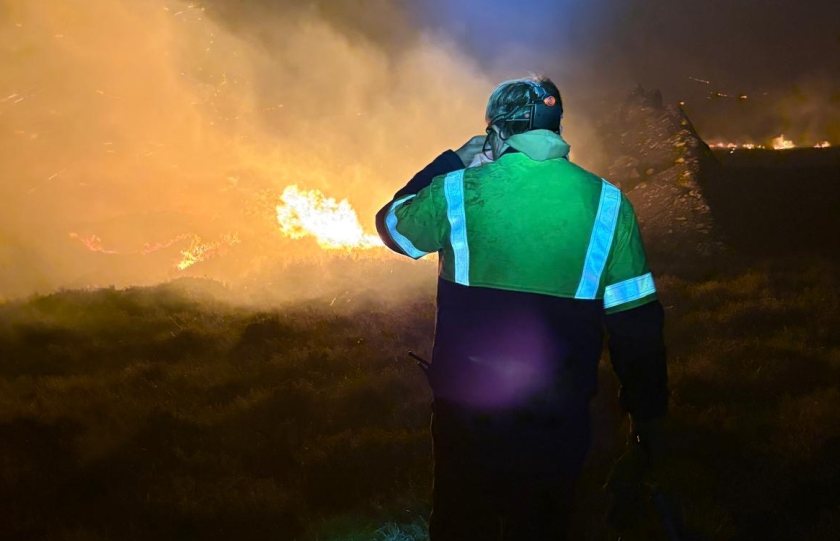
Farming and rural businesses that helped battle Scotland’s worst wildfires on record are beginning to receive financial support, after nearly 12,000 hectares of moorland and woodland were destroyed during blazes earlier this summer.
The first tranche of a wildfire recovery fund has now been paid to rural businesses whose equipment was damaged while tackling the fires, with further funding expected early in the new year.
The support is intended to compensate for losses and allow the rapid repair or replacement of vital machinery, much of which was deployed at the businesses’ own expense during the emergency response.
Scottish Land & Estates (SLE) said the funding recognises the scale of the contribution made by land-based businesses, many of which absorbed significant costs while helping to contain the fires between Dava and Carrbridge in late June and early July.
Ross Ewing, director of moorland and strategic projects at SLE, said swift action by public bodies had helped offset some of those losses.
“Decisive action by the Cairngorms National Park Authority – supported by the Scottish government – has resulted in this swift distribution of funds to offset some of the losses sustained,” he said, welcoming what he described as proactive partnership working with farmers, gamekeepers, land managers, crofters and rural communities.
The grants are being delivered through the Cairngorms National Park Authority as part of its wider wildfire response. Colin McClean, the authority’s head of land management, said the funding reflects the essential role played by rural workers during the crisis.
“Hundreds of gamekeepers and land managers pulled together to fight the fires this summer, with many providing specialist equipment which was essential to bringing the situation under control,” he said.
He added that the support forms part of commitments set out in the authority’s Integrated Wildfire Management Plan and that close collaboration with land managers would continue into 2026.
A report commissioned by the Scottish government and produced by SLE in July highlighted the scale of the rural response, estimating that nearly £4 million of specialist firefighting equipment was deployed, helicopters were used for more than 96 hours and around 110 staff were involved. Of those responding, 79% had practical muirburn experience and around two-thirds were formally trained.
The fires have intensified debate over wildfire prevention and land management, prompting the Scottish government to delay the introduction of muirburn licensing until autumn 2026 following discussions with land managers, gamekeepers and the Scottish Fire and Rescue Service.
Mr Ewing said the events of this year had demonstrated the need for better coordination and preparedness. “The threat posed by wildfire is increasing and this year’s massive fires demonstrated the importance of coordinated, partnership working to help better prepare for and respond to, these events,” he said.
He added that ministers had taken “a pragmatic, evidence-led approach” and said the funding recognises both the damage sustained and the ongoing need for collaboration between the private sector, the fire service and public bodies.
The funding follows Scotland’s first national wildfire summit, hosted by the Scottish government in October, which brought together firefighters, land managers, fire behaviour experts and rural workers.
The summit is expected to inform a longer-term strategy aimed at improving wildfire prevention, preparedness and response as climate pressures increase.