

£150m Essex greenhouse approved in boost for UK food security

A £150 million greenhouse development in Essex has been approved, in a move that could strengthen domestic food production and reduce the UK’s reliance on imports.
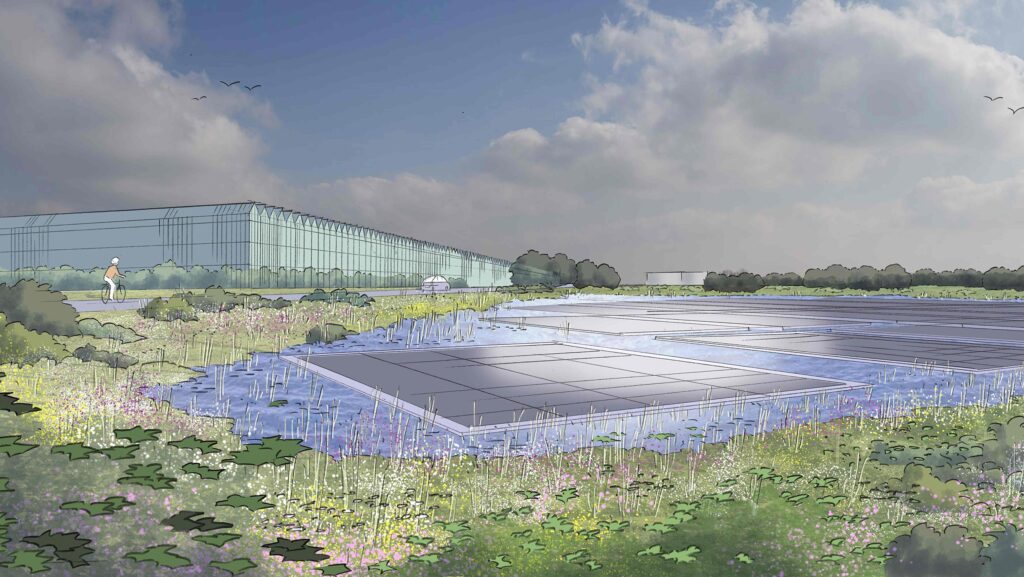
Essex County Council has granted planning permission for the Rivenhall Greenhouse project, which is set to become one of Europe’s largest low-carbon controlled environment agriculture (CEA) sites. The decision comes as UK growers continue to face pressure from rising costs, labour challenges and volatile supply chains.
The scheme, led by Rivenhall Greenhouse Limited, will combine large-scale glasshouse production with integrated energy infrastructure to deliver year-round supplies of fresh produce. It is expected to focus primarily on tomatoes, with the flexibility to grow crops such as cucumbers, peppers and strawberries.
A central feature of the development is its partnership with the nearby Indaver Integrated Waste Management Facility. Through this arrangement, the greenhouse will secure around 90% of its heat, along with all of its electricity and a sustainable source of CO2 for crop production.
Developers say this circular approach will provide a more stable and predictable energy supply compared to conventional systems, helping to shield the business from the volatility that has affected many UK and European growers in recent years.
That resilience could prove increasingly important as energy costs continue to rise across the sector.
Farmers and growers are bracing for soaring electricity bills as new charges come into force, adding further pressure to already stretched businesses.
The NFU has warned growers face a “double whammy” of rising costs, with increases to Transmission Network Use of System charges — fees linked to maintaining the electricity network — set to begin in April.
In some cases, these charges are expected to double, with large glasshouse operators facing increases of more than £1 million a year.
The changes could add hundreds of millions of pounds to costs across the sector, placing additional strain on energy-intensive businesses already dealing with volatile markets.
In that context, developments such as Rivenhall — which secures the majority of its energy through industrial co-location — are likely to become increasingly attractive as growers look to protect themselves from market volatility.
The approval also comes amid continued reliance on imported fruit and vegetables, particularly from southern Europe and North Africa, where extreme weather events have disrupted production.
This dependence has exposed vulnerabilities in the UK food system, contributing to supply shortages and price fluctuations in recent years.
By increasing domestic output, the Rivenhall site is expected to improve supply chain resilience, reduce food miles and support greater consistency in availability.
At full capacity, it could produce up to 30,000 tonnes of tomatoes each year — equivalent to around 7.5% of current UK imports — with scope to grow cucumbers, peppers or strawberries.
The project is also forecast to create more than 400 jobs and support the development of skills within the horticulture sector, while reinforcing Essex’s position as a centre for greenhouse production.
Ed Moorhouse, project director at Rivenhall Greenhouse, said the development represents “a blueprint for the future of UK CEA — demonstrating how scale, advanced technology, and industrial co-location can be combined to transform the economics, carbon intensity and resilience of food production”.
He added: “Today's decision marks the culmination of four years' intensive work… This is a good day for UK horticulture and the nation's food security and resilience.”
Micheal Geary of Indaver said the approval “is a strong endorsement of the role that industrial collaboration and circular economy thinking can play in supporting the UK's future food security”, adding that the project “sets a new benchmark for sustainable infrastructure”.
Richard Gudgeon of Wren Renewables said the development “further complements the renewable credentials of the site”.
While the project highlights the potential for large-scale domestic production, questions remain over how quickly similar developments can be delivered nationwide.
Industry leaders have pointed to the need for planning reform, investment incentives and clearer recognition of CEA as a strategic infrastructure priority.
With several comparable projects already identified across the UK, the Rivenhall approval may prove a test case for whether Britain can accelerate its shift towards homegrown food in an increasingly uncertain global market.