




Banish tyres - Don't bale!
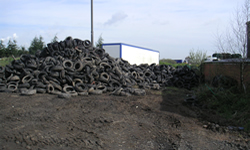
"Many farmers are ditching the long established practice of holding down silage sheets with tyres and opting for the more modern way of keeping sheets in place and silage in good condition through using polyethylene woven sheets, such as Syloguard Protective sheeting", says David Parkes.
"These protective sheets have many benefits and are expected to last at least ten years but farmers are still being left with the problem of what to do about the piles of unwanted tyres which are a 'waste' and a liability whilst left on their land.
"The baling of these tyres is currently being promoted as a potential solution to this problem, but is it really the answer or rather a short term fix to comply with Agricultural Regulations which now treat old tyres on farms as waste and subject to the same legislative controls as waste tyres from other industries?
"When baled, tyres still remain a 'waste' and are therefore still a waste liability on the farm and to the farmer. Bales must be used for a construction purpose and cannot be just baled and 'dumped'. In addition, tyres do not have an ultimate shelf life when baled. If moved a few times the bale wires can break and the tyres will be loose again and with protruding wire will pose a danger to workers and farm animals. Similarly old tyres from silage clamps can already be 'rotten' with protruding steel. Farmers may well find that they are paying out twice – once for the baling and again when they eventually find they have to dispose of the tyre bales from their farms.
"We cannot afford to be complacent about current regulations which are constantly evolving - and although the Environment Agency is taking a 'non enforcement' position on baled tyres at present - this may well change in the future.
"Farm tyres are contaminated and therefore it is more difficult to find disposal points as most re-processors and tyre burning plants will generally not accept them, preferring 'fast fit' clean used tyres which only leaves 'low grade engineering' schemes for the disposal point and an end use.
"The Environment Agency is increasingly more prescriptive about the levels of contamination accepted at these sites and very soon this could lead to extensive pre cleaning costs for loose tyres on farms prior to disposal. If the tyres are baled, they would be more difficult to remove, requiring the breaking of the bales, adding yet another cost and making them even more expensive for the farmer to ultimately dispose of.
"So, don't bale, banish, and get those tyres gone now as the cheapest option in the long term! "




