




Butterflies thriving in Cambridgeshire
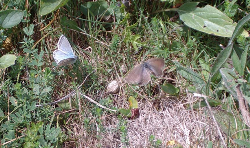
Next week is Save our Butterfly Week and in Cambridgeshire a range of scarce butterflies is being safeguarded thanks to the work of a local farmer and Defra funding awarded by the Rural Development Service.
During July and August hundreds of adult Chalkhill Blues, Polyommatus coridon, emerge to grace a remnant of chalk grassland in the old railway line between Swaffham Prior and Burwell, offering a spectacle that is scarce in the East of England. Also at the site are Common Blue, Polyommatus icarus and Brown Argus, Aricia agestis as well as a small population of Britain's smallest resident butterfly, the Small Blue, Cupido minimus.
The site is managed by the owner John Clarke who maintains a delicate balance of conditions suited to the Small Blue, Chalkhill blue and other butterflies as part of a ten-year Countryside Stewardship Scheme (CSS) agreement. Because viable populations of these butterflies are limited to suitable grassland with sufficient quantities of their specific foodplants, they are confined to small areas of Britain where sympathetic management ensures their future.
Dr Nigel Russell, an adviser for the Rural Development Service in the East of England, said:
"Management of this site maintains a mosaic of short and taller areas of chalk grassland with restricted areas of scrub vegetation.
Occasional bare patches of soil are deliberately maintained to allow seed of kidney vetch to germinate. In addition to providing habitat for Small Blue and other butterflies, this detailed management has wider benefits in maintaining a diverse grassland flora, complimenting adjacent chalk grassland in the Devil's Dyke Site of Special Scientific Interest (SSSI).
"Aside from benefits to wildlife, this embanked section of the old railway line is worth preserving in its own right. Elsewhere, little remains of the line as it has been incorporated into arable farming.
This surviving remnant is part of the local landscape and a historical legacy of our former rail network."
The site near Burwell is actively monitored by conservationists at Butterfly Conservation and the local Wildlife Trust.
John Clarke, farmer, said:
"Without Defra's agri-environment schemes the wildlife may suffer as farm income declines. It is very important to keep cutting back the scrub every year, otherwise it would take over the site wiping out the plants and the butterflies which depend on them. The Countryside Stewardship Scheme is now helping us to maintain the delicate balance required."
Sharon Hearle from Butterfly Conservation said:
"Butterfly Conservation is delighted that sensitive management is maintaining an important butterfly habitat at the old railway line. The best place to see the Chalkhill Blue this week is from the public footpath that runs along the neighbouring Devil's Dyke."
Martin Baker, Conservation Manager, The Wildlife Trust for Bedfordshire, Cambridgeshire, Northamptonshire and Peterborough said:
"This section of the dismantled railway line contains some of the most diverse chalk grassland flora in any of the region's county Wildlife Sites. The presence of Horseshoe Vetch, Kidney Vetch, Sainfoin and Rockrose are indicators of the quality of the grassland, offering excellent habitat for butterflies and other invertebrates".
The Countryside Stewardship Scheme was replaced in March 2005 by Environmental Stewardship. It is composed of three elements, Entry Level Stewardship, Organic Entry Level Stewardship and Higher Level Stewardship.




