




Double yolker groundhog day!
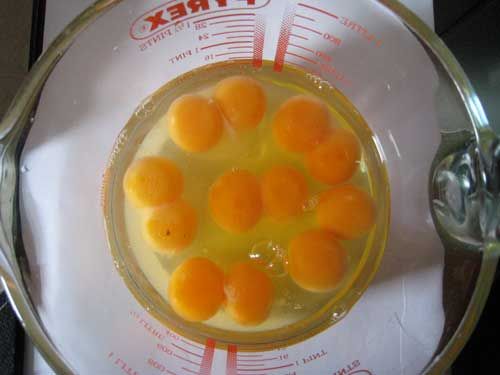
Mark and Alison Turner purchased a dozen fresh eggs from the butchers in West Sussex. The eggs were randomly selected from a basket. Six eggs into one box and six into another. All the eggs in the first egg box were double yolkers, whilst there were no double yolkers in the second box. Without knowing the number of eggs in the basket, or the alignment of the moon against venus on this day we can at least agree that the chances of this are very slim.
What we can at least do is explain the reasons behind this statistical enormity.
Farming UK asked Trevor Bray to explain the reasons we get double yolkers!
Yes, the eggs bought from the butcher were certainly a good buy and we are glad they enjoyed eggs for breakfast. Oh, if only everyone did that!!
Obviously, one cannot be certain what the reason was but there are clues in the story that are of help:
1. The eggs were bought from a local butcher. It is highly likely therefore that they purchased the eggs from a single farm. It was not stipulated that they were graded as Large eggs or possibly Very Large ones, but it is likely that they were and that is probably what the butcher requested from his supplier.
When the eggs were selected from the basket, I suspect that they chose the largest first followed by the almost as large eggs, which were put into the second box.
2. It is possible that on that particular farm there were two flocks of hens. However, most importantly, one of these flocks was almost certainly aged about say 20 – 23 weeks old. If there was another flock on the farm, it would almost certainly have been older.
3. The biological clue to the cause of all of those double yolked eggs is almost certainly associated with the age of the flock. So to understand what probably happened, we have first to look into the physiology of the laying hen. Here goes:
Hens have a single ovary. However this ovary consists of a mass of loosely connected, yellowish, rounded objects each containing an ovum. The ovum is potentially the yolk of an egg. Unlike humans, the number of ova (the plural of ovum) may run into millions, but most do not reach maturity. When a pullet reaches the stage when sexual development occurs, normally when about 17 – 19 weeks old, some of the ova start to increase in size. These are the yolks of the eggs that we eat, i.e. they start as droplets of yolk which are situated on the ovary. The blood supply to them results in their development. Each ovum (yolk) is surrounded by an ovarian pocket. This pocket retains the developing yolk (ovum) until it reaches maturity. At this time the yolk is released into the infundibulum, which is a funnel-shaped structure that grasps the yolk as it is released from the ovary. The infundibulum is the first part of the oviduct, which is really an egg making conveyor belt within the hen. As the yolk passes along the oviduct the thick albumen (white of an egg) is formed around the yolk followed by the thin albumen. The membrane then encloses the yolk and albumen, after which the shell is formed, the cuticle is added to the outside of the shell and the finished egg passes out of the cloaca, when the hen is hopefully in her chosen nest box.
You can see that the formation of an egg is a complicated business, which can occasionally be accident-prone! For a double yolked egg to be laid there has to have been a slip up in the egg formation process. I mentioned that the yolk (ovum) is held in a pocket until it is released and that there are a great many yolks in various stages of development.
So a double yolked egg is similar to humans having twins i.e. two yolks (ova) are released into the infundibulum at once and it manages to catch them both.
This pair of yolks are then surrounded by the albumen, membrane, shell and cuticle, as for a single yolked egg.
The size of an egg is closely correlated with the size of the yolk. The bigger the yolk, the bigger the egg. Therefore if two yolks are contained within an egg it is likely that the egg will fall within the Large or possibly the Very Large grade.
Within a young flock of hens there may be some accident-prone ova where the sudden hormonal rush of the commencement of the laying period leads to the surge towards maturity in the development of the ova (yolks). So instead of it being clear which is the biggest (most mature) yolk to be released today, two of them of a similar size are released at the same time. This flock, when aged at about 20 – 23 weeks normally has most eggs falling into the Small grade with some Mediums too.
There may be just a very few single-yolked Large eggs. However, maybe about 1 or 2% of the hens have released two yolks at the same time into the oviduct and these double-yolked eggs stand out as being larger than the majority of the eggs that are laid at that time. It is likely that Mark and Alison Turner’s eggs in one of the boxes that they purchased came from this young flock of hens. The box that contained no double-yolked eggs was either from the very few Large grade eggs that come from a young flock or they probably came from an older flock. The release of the yolks into the oviduct soon comes under better control, leading to most eggs being single-yolked and thus offering no fortunate and interesting mistakes for satisfied customers who purchased them.
I hope that this miniature lesson in the biology of the laying hen may have helped with the query. A useful tip: If you are choosing eggs from a basket that contains Large grade eggs, the ones with double yolks may possibly have shinier and better quality shells than the single yolked ones that may have been laid by older hens.
If you have an odd egg story. Send it in to the Ranger




