




New Figures Give Renewed Hope for the Wild Grey Partridge This Christmas
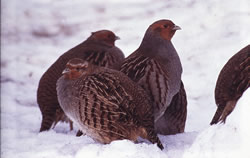
The wild grey partridge, immortalised in the traditional Christmas carol, The Twelve Days Of Christmas, has seen a massive 85% decline in its population over the past 30 years, but new figures released by the BTO show that the species may at last be turning the corner.
This quintessentially English species has been recorded as far back as the Iron Age. But in the past three decades numbers have plummeted to such an alarming extent that it has become a Government Biodiversity Action Plan species, with The Game Conservancy Trust appointed lead partner for the plan.
This latest report from the BTO, which shows a 5% increase in the UK wild grey partridge population, was welcomed by the Trust which sees this as a very important milestone in securing the bird's future.
Dr Nicholas Aebischer, Deputy Director of Research with the Trust said, "It is estimated that in Edwardian Britain there were about one million pairs of grey partridges, but even with the latest 5% increase, the partridge population is currently very low, standing at just 80,000 pairs."
"The last two warm summers and a big increase in the number of landowners and farmers implementing a range of management measures recommended by the Trust such as creating the right habitats, providing sufficient food and carrying out predator control, are beginning to make a difference. It can only get better for the grey partridge."
The Game Conservancy Trust is spearheading a massive campaign to halt the decline of the grey partridge and has raised in excess of £450,000 to fund a £2 million research programme. In addition, the Trust is enlisting the support of over 1,350 farmers and landowners across the country to join in an annual count scheme to help conserve the grey partridge.
In certain areas, such as Northern Ireland, Wales, the south east and west, including Cornwall, Devon, and Somerset, the grey partridge has virtually disappeared completely. In Sussex, Hampshire, Wiltshire, and Kent, the population remains very low. But in areas including Norfolk, Lincolnshire, Northumberland, the Borders and Lothian the species is showing an encouraging increase.
Where numbers are starting to respond there is evidence that the increase directly corresponds with landowners implementing a number of habitat changes developed by the Trust including managing set-aside for wildlife and the creation of arable grass margins. Many of these are now incorporated in Government agri-environment Stewardship Schemes.
The Game Conservancy Trust would like many more landowners, farmers or individuals to participate in the Partridge Count Scheme, so that it can monitor changing densities and geographical distribution more accurately. In addition, The Trust can offer advice to landowners on habitat improvements and management techniques specifically suited to the needs of the wild grey partridge. In some cases grants may be available for this purpose.




