




One producers battle with crop impaction
Chickens do what chickens do and need close supervision in order to get the best performance possible. With this in mind there follows a report on our personal experience with our latest flock which is now 39 weeks old. Before their arrival the shed had been empty for longer than usual but had been subject to a rigorous cleaning programme. The pullets arrived at 17 weeks old and looked strong and healthy. According to our usual plan, they were ranging well at 19 weeks and were coming into lay. We were keeping floor eggs under control with inventive use of pyracantha branches in problem corners and mortality was very low at about 0.1%. Production reached just over 93% at 23 weeks old and we were pleased with the progress of the flock.
Then, mysteriously, production began to fall by one or two percent each week. At first we thought that this was just a normal dip in production, often seen at peak lay, but this was not the case. The flock looked very healthy and they had increased in weight as expected with appropriate evenness data.
Then the evenness results decreased in value and a few birds were seen sitting in the litter area looking ’miserable’. These were not small or being bullied but were well grown birds. It was suggested that the flock might have a problem with a high worm burden. We sent samples of faeces and soil from outside the shed for worm egg counts and the results returned showed less then 100 eggs per gram so this could not be the source of the problem.
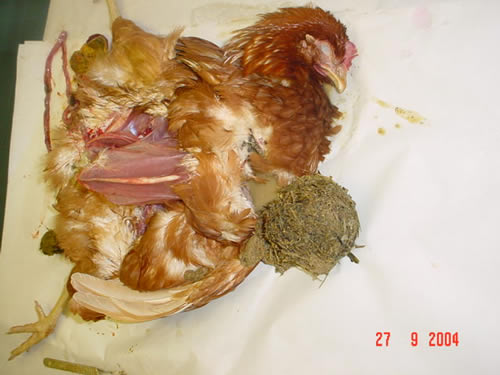
By this time production had fallen to 82% and the birds were 28 weeks old. At this point we culled two of the sick birds and opened the gizzard and intestines. To our surprise we found these organs contained nothing but fibrous plant material which in the upper intestine was formed into a ball causing a blockage of the gut. It appeared that the sick and dying birds were suffering from malnutrition and slowly starving to death. It was easy to see that the problem would have symptoms similar to a very high parasitic worm infestation.
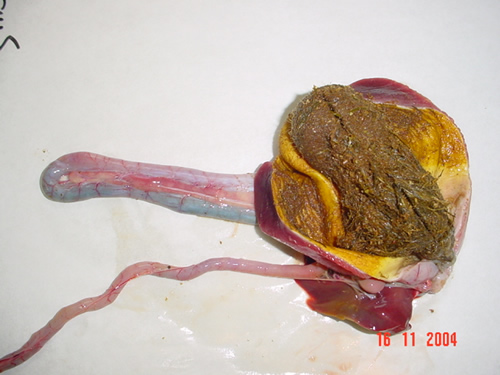
The remedy was not immediately obvious. We fed 50kg flint grit to the flock over the next seven days to ensure that the birds could grind up the plant material they were eating. At this point the mortality rate began to rise from almost nil to 10 or 15 birds each day. Post-mortem examination of four sick birds confirmed peritonitis caused by E. coli, presumably as a consequence of the stress caused by the gut problems which had occurred at peak lay. The flock was treated with an antibiotic, Coliscour, and three days after treatment was completed the mortality decreased. Production, however, remained at 82%. We had no idea how, when or if the flock would recover.
We found the following reference to impaction of the crop in a commercial laying flock:
"If birds of any age that have not had grit are transferred to free range where they have access to stemmy grass or if they are bedded on straw … , they will consume these materials and some will suffer from impaction." (The Poultry Farmer’s and Manager’s Veterinary Handbook, Peter W. Laing, Crowood Press 1999 pp100-101). The book recommends laying hens have access to insoluble grit from an early age as ".. this helps to develop the muscular power of the developing gizzard and enables the bird to grind up fibrous material that it would otherwise not digest." (ibid pp 68)
This is a problem we have not encountered before and may involve several factors including the enthusiasm of the flock to range and more vegetation on the range than usual. The flock is now 38 weeks old, the birds are healthy but production is still running at about 82% and we have no idea if this will improve. There is always something new to learn however long we have been keeping hens but we always try to be wiser in the future.
The Ranger presented Mary’s article to Humphrey Feeds. Their specialist feed team of Mick Dennet, Anthony Harman, Steve Clout and Colin Gravatt provided the following analysis based on their combined experience.
Fortunately this is not a common problem, particularly as birds do not always sufficiently to return to full lay. In our combined experience of over 65 years of providing advice to the free range poultry industry we have encountered around 12 cases, although like many performance problems there is often a number of contributory factors, often interlinked that create varying symptoms, so pointing the finger at one single factor is often difficult.
Recognising the problem
Recognising any problem early is the key to controlling potential losses. Our advice therefore would be to weigh birds weekly, checking that evenness is progressing in line with the breed target weights. Ideally flocks should have a maximum range of 300g between groups of birds at the top and bottom of the weight range. If the gap widens, then the smaller birds are suffering for some reason, a warning sign that needs to be thoroughly investigated. When weighing the birds, any light, underweight breast muscle should be checked. The muscle should be slightly convex, not concave.
The particular condition in question here is usually identified following post mortem on dead birds. A farm post mortem is sufficient as the problem is easy to see in the gizzard – a plug of grass/vegetation. Bird weight is often affected and of course production takes a dip. Birds will often become less mobile and in some cases appear to have swollen gizzards. We have come across one flock where the farm manager went through the birds getting them to regurgitate the plug by squeezing their gizzard. The flock subsequently recovered although not to peak performance.
A normal gizzard should contain grit, and any grass should be short or completely ground down. Always check for worms.
Steve Clout said "It is one of the first things I look for now. I find that the gizzard is always a good place to start - looking for foreign objects such as red or blue stain from mouse poison or egg shell from egg eating if production is dipping, berries from the range or compacted long grass or vegetation."
Some of the affected birds never come back into lay, and some will only lay 2 eggs a week instead of 6-7. If any of the birds do come back into lay, it will be 8-10 weeks later, just when some of the birds are coming off their peak, so you never really see the birds coming back into lay. This can appear like a straight line production of between 80 and 85% for the rest of the flock.
Causes
In severe cases it is usually caused by a craving or a deficiency in the general management of the birds. This deficiency is usually hard to define, and could have occurred in rearing or early lay.
It can relate to a feed deficiency, something that is not in the feed, or that the feed is not entirely palatable, dusty or stale.
Mick Dennet said that the commonest cause is young birds coming into lay early in spring are more susceptible due to their high nutritional requirements. If the flock is early into lay their nutritional demands are higher and they can go mad for grass. The birds are trying to sustain greater, earlier output of eggs. If the grass on the range is long then the likelihood of problems will increase.
Treatment and Prevention
Keep the grass short, and make granite grit available (not flint as its sharpness can damage the gizzard). Hen sized grit should be available in feeders. The birds will usually help themselves. Initially the birds may over consume, but they will soon regulate their intake.
If any of the range is mown at any time during the laying cycle then mow with a flail mower rather than a swath mower as the flail will condition ie damage the fibrous stems of the grass and make it more digestible. Alternatively remove the cut grass or graze the range rather than mow it, although neither of these solutio




