




Quality speakers address conference
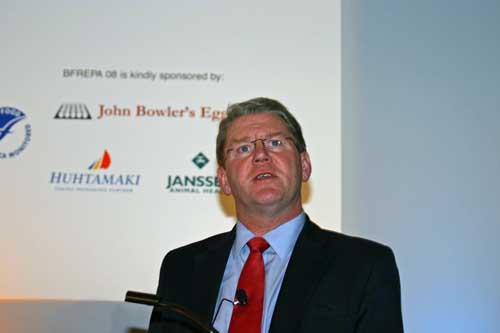
NFU president Peter Kendall stepped into the debate over prices paid to farmers when he addressed members of the British Free Range Egg Producers Association.
Producers are angry at recent cuts in the price they receive for their eggs, and Peter Kendall appealed to retailers to take a longer term view during a speech at BFREPA’s annual conference. "I have had many examples in recent weeks of short term retail behaviour. There are some good examples where retailers work with us and I would like to see us team up with retail partners. I would like retailers to resist short term downward pressure," he said.
He said that in the banking industry short term thinking had damaged confidence in the free market system. He said he was issuing a genuine appeal to the retail sector not to go down the same road as the banks - to work with the farming industry and look to the long term rather than face the possibility of a heavy handed retail ombudsman.
The NFU president praised the egg industry for the way it had turned around its fortunes in recent years, but he had some words of warning about what might happen in 2012 when the ban on conventional cages is due to come into force throughout the EU. His concern is about how the EU will deal with those who fail to comply with the ban by the time the deadline falls.
"Our message is that we will strive to be there in 2012. There will be others who will not be there in 2012. Where will our competition be in 2012? How will countries be able to get away with not meeting the rules?"
He said that 70 per cent of the pork being imported into Britain at the moment would be illegal under standards in place here. He said it was not allowed under the rules of the World Trade Organisation to prevent such imports. It was not right that the UK could not impose on imports the same standards with which its own producers had to comply and he said that there would be lobbying for this to be changed in the next round of WTO negotiations.
Peter said the Government had suddenly started waking up to the importance of food production. The prime minister, himself, had attended the NFU conference and had said there was a change in the view that food would ’always be available’. He and his Government had started taking more interest in food and farming issues.
"Government reports say we need to double food production by 2050," he said. "One report suggests that potentially by 2050 half of the arable land around will be unusable. We have a chief scientific advisor saying we need to change our attitude to productive farming. Food security is back on the agenda."
Those who attended the conference were told that there were great opportunities ahead for eggs.
The optimistic message was delivered by Amanda Cryer, director of the British Egg Information Service, who said that the egg industry had the support of the public, retailers and the media. "They all have a very positive perception of eggs, but that has to be matched by reality," she said. "We have a habit of knocking success in this country and we have to ensure that what people think about eggs is matched by what we produce."
Today’s public faith in the egg industry is in stark contract to 20 years ago when Edwina Currie threw the industry into crisis. "It is 20 years ago next Wednesday since Edwina’s famous words," said Amanda Cryer. "Ten years later the industry was still facing a very negative attitude towards eggs, but November 1998 was the beginning of what I would call the future."
She said it began with detailed consumer research which analysed public attitudes towards eggs. That research showed that people were still worried about eggs and health. It also showed that consumption of eggs was falling fastest amongst key consumers - mothers with children.
In 1998 a new code of practice was launched. Salmonella vaccination was introduced and money was invested in television advertising to explain to consumers the meaning of the Lion on the egg.
Confidence returned, she said. Even Edwina Currie showed her support for the Lion egg. By 2002 the industry had made a great deal of progress. Research showed that people were no longer worried about eggs, although there was a certain amount of ambivalence towards them.
The industry had addressed this ambivalence with campaigns like Make a Meal of Anything. The media had been persuaded to publish recipes making use of eggs in interesting ways, there had been messages showing why eggs were good for you and one particular piece of research from the United States suggested that two eggs for breakfast could help you lose weight. "That was very good for us," said Amanda.
To mark the 50th anniversary of Lion, she said, the British Egg Information Service had intended to revive the famous "Go to Work on an Egg" ads remembered fondly by all who grew up through that particular generation.
When the advertising authorities ruled it could not do so because the ads did not show a balanced diet, the media leapt to the defence of the egg industry. "Everyone supported us. We had more coverage than if we had run the ads and no-one was on the side of the advertising authorities," said Amanda. "It was an interesting sign of the times."
She said that the results of market research today were very different from those 20 years ago. People loved eggs, they were seen as healthy - particularly amongst young people, they were seen as economical and people were responsive to new recipes.
She said that salmonella figures were down and eggs were not being named as a cause, sales were up and the Lion egg enjoyed 90 per cent share of the market. The egg industry was the envy of other farming sectors, she said.
In recent surveys, consumers mentioned free range eggs unprompted for the first time. They said they were tastier, healthier and ’looked more like an egg should." In the view of consumers surveyed, a happy hen produced happy eggs, said Amanda.
British Egg Information Service initiatives for the next year included a new web site and new point of sale material. An Eggs Factor campaign, which travelled the country seeking out people’s favourite egg recipes, was being extended into schools as Eggonomics.
Richard Geldard spoke to conference about his family’s farming operation in Cumbria. The Geldards’ Low Foulshaw Farm, Gilpin Bridge, Levens comprises 480 acres plus additional rented land. Richard assumed responsibility for the day-to-day running of the farm business in 2003 and under his management the farm expanded the size of its poultry enterprise from 25000 to 40000 free range hens. Low Foulshaw Farm also has 130 suckler cows plus followers, 120 pedigree Charollais ewes and 900 Lleyn ewes.
The Plumgarths food park which the family developed on the farm and which incorporates a farm shop, meat cutting plant and bakery, now generates annual turnover of £5 million and provides employment for local people. The enterprise supplies local hotels and also acts as a sourcing hub for supermarkets. Eggs go to two supermarket chains, hotels, food manufacturers, schools and care homes.
Richard Geldard is a council member of the Royal Agricultural Society of England, a member of the awards committee steering group for the Royal Agricultural College and a member of the NFU North West Poultry Board. He co-presented a paper to the Royal Agricultural College on the challenges facing the family farming business.
Richard said that there was now a very good public perception of the egg industry and farming generally. "When I was leaving school there were so many negative images of the industry. Now well known chefs are banging the drum for agriculture and there is more interest in food. I am very optimistic about the future."
One cr




