




Retail competition keeps prices down
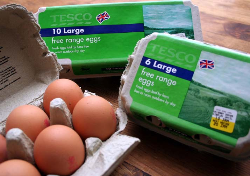
Despite growing calls for an improvement in the free range producer price, competition between supermarkets is set to keep prices depressed for some months yet.
That was the message that came out of a meeting between BFREPA and the packers' representative body Nemal.
David Tromans, managing director of Deans Foods, told association officials that while the market overhang that kept producer prices down last year last year was disappearing, intense competition between retailers meant there was still a downward pressure on prices.
Last month's Ranger revealed that up to 8p a dozen had been knocked off the retail price of free range eggs in a price war started by the UK's number one retailer Tesco.
"An improvement in the supply and demand situation should give us a better opportunity to improve yields to producers but this will be against a background of an increasingly aggressive retail market," said Mr Tromans. "At the moment, I can't see a price increase coming early."
This view was echoed by Stonegate's commercial director Nick Rogers who said that although the indications were that the free range market would tighten later this year, it was difficult to predict when this might result in improved producer prices.
But BFREPA chairman Tom Vesey laid out the case for an immediate price rise, telling the packers that producers were having to absorb cost increases from every angle.
"Our members are facing spiralling production costs," said Tom. "Whether it's feed, pullets, wages, electric or diesel, it all ends up back with the primary producer and, with no one to pass it on to, these costs have to be absorbed.
"But that can only go on for so long and producers are now being squeezed hard.
"We understand that the retail market is a competitive one but retailers also need to be aware that a shortage of free range eggs could be just around the corner if returns don't improve."
While packers have rested comfortably safe in the knowledge that an endless stream of would-be producers was on hand to fulfil their needs, Tom believes that is changing. "It's hardly surprisingly that the threat of avian influenza has caused some farmers to rethink their plans about sinking hundreds of thousands of pounds in a new free range enterprise," said Tom. "And even if they do still want to go ahead, they are finding that the banks are taking a cautious approach when it comes to lending money to poultry farmers. Applications for funds are coming under far more scrutiny than they were this time last year."
There is also reluctance among existing producers to expand their units, says Tom.
"Confidence has evaporated and producers are questioning whether the rewards on offer are now worth the risk."
...but sales keep growing
The latest supermarket sales figures back up the prediction that free range eggs could be heading for a shortage if the supply tap is slowly being turned off.
Data from retail analysts TNS show that free range enjoyed a 10 per cent increase in sales volumes during 2005, giving the sector a 32 per cent share of all supermarket egg sales. Organic eggs achieved similar sales growth last year—increasing by around 8 per cent—and accounted for 3.4 per cent of the market. Despite a 5 per cent drop in sales, cage eggs still remain the dominant sector at just short of 60 per cent of total volume.
Barn eggs underwent a revival last year, achieving a 24 per cent increase in sales, largely due to Asda and Sainsbury's substituting their premium cage lines with barn. But 2005 will be remembered as the year that free range and organic sales overtook cage in terms of value. The combined worth of free range and organic was £241 million against £237 million spent on cage eggs.




