




Trial highlights varying impact on soil compaction between tyres
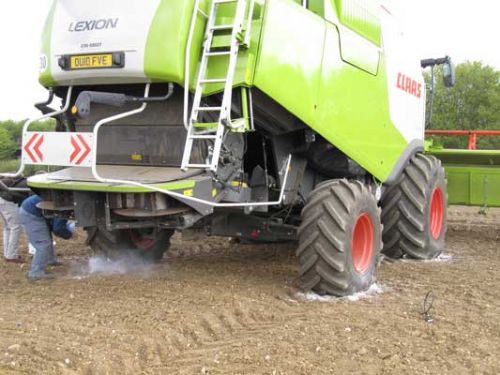
A trial conducted by an independent soil scientist has found significant differences in the level of soil compaction from a combine harvester, depending on the make and type of tyre fitted. This can have a significant impact on plant root growth and yield potential.
The trial was carried out by Philip J Wright BSc (Hons) C Eng MI AgrE, using a Claas Lexion APS Hybrid Combine at the manufacturer’s headquarters in Saxham.
It tested Michelin’s new CerexBib combine harvester tyre, which uses Michelin’s patented Ultraflex technology, against conventional agricultural tyres commonly fitted to combine harvesters. This included Michelin’s MegaXbib and MachXbib tyres, plus standard fitments from two other tyre manufacturers.
The Claas combine made two runs through the field for each tyre configuration, with soil compaction measured using a penetrometer at positions chosen randomly along the path of the tyres. To ensure the maximum effect, both front and rear tyres were taken into account and all measurements were compared to the "control" of un-trafficked areas of the field between the wheels.
The recorded data found a significant difference in the mean level of soil compaction between the Ultraflex technology and conventional technology tyres. The CerexBib fitments created a significantly lower level of compaction, mean 1099kPa, compared to the other makes of tyre. Michelin’s MegaXbib (front) and MachXbib (rear) fitment recorded a mean compaction of 1425kPa, compared to 1506kPa and 1603kPa for the two other tyre brands.
Commenting on the results, Philip Wright explains: "Overall, it is clear that for depths to 25cm, the compacting effect of the Ultraflex technology tyres is significantly lower than the conventional tyres which all give broadly similar effects. Plant root growth, and yield potential, will therefore be less adversely affected by using CerexBib tyres than the other conventional technology fitments."
Prior to the trial the ground had been loosened by running a subsoiler in two directions at right-angles across the field. Surface re-consolidation had taken place via a roller attached to the subsoiler, to leave a reasonably consistent profile to the loosened depth of between 325 - 350mm. The soil type was a sandy loam, at low moisture (approximately 13.5% DB at mid-profile) content.
All readings for soil resistance were taken over a six hour period of fine weather, so eliminating any soil moisture variations. Soil resistance (pressure, in MPa) was measured by a Spectrum Technologies digital cone penetrometer which enabled all data to be logged relative to the depth of measurement in each case.
Throughout the trial tyre inflation pressures were set according to each manufacturer’s recommendations for the relevant axle loadings, which included road mode without header, plus in the field fully laden with header attached.
CerexBib tyres
Developed in conjunction with Claas, the Michelin CerexBib was launched in August 2010 and was initially available exclusively on the Claas Lexion range of combine harvesters. It has since been launched onto the replacement tyre market with sizes including the IF 680/85 R 32, VF 520/80 R 26, IF 800/70 R 32 and VF 620/70 R 26. A further six sizes are expected to be launched before the end of 2011.
CerexBib is unique for being 15 per cent narrower than any conventional harvester tyre of the same load index and diameter. This reduced width allows manufacturers to build larger harvesters without exceeding a width of 3.5 metres; the critical point at which European Union regulations stipulate that harvesters require special order movements from the Police and on-road escorts.
Michelin says the key to achieving this impressive performance advantage is its Ultraflex technology, with CerexBib being the only commercially available harvester tyre which can work at a pressure of less than 2 bar (29psi). This is around 30 per cent less than conventional tyres.
Commenting on the CerexBib range, Rob Beddis, Commercial Director of Michelin’s Agricultural division in the UK and Republic of Ireland, says: "The larger contact patch and lower ground pressure not only reduce rut depth and soil compaction, but they increase traction on wet and dry soil, saving farmers time and increasing fuel efficiency.
"The extremely flexible sidewalls on the CerexBib tyres also considerably increase ride comfort. Even at low operating pressures, the CerexBib delivers safer driving on road and superior stability. Steering response is also improved, while vibrations and noise are considerably reduced," he concludes.




