




Export dominates Netherlands free range egg market (Netherlands special part 1 of 4)
This is the second in our series of roving reports looking at the free range egg market in various parts of the world and how it compares with our own market.
Free Range egg production in the Netherlands is unusual in that it is destined almost exclusively for the export market. This obviously has implications for Dutch producers; so before we begin to look at how the Dutch Free Range industry operates, it is first necessary to understand how the situation arose.
THE MARKETPLACE
'Alternative' egg sector dominated by barn eggs
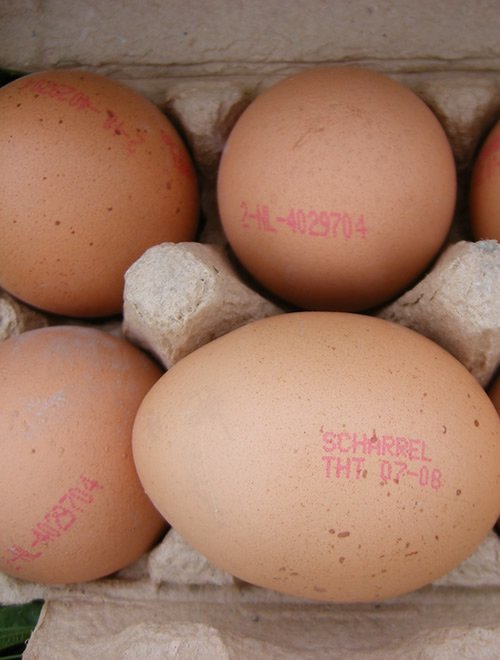
'Alternative' egg production is very strong in Holland, and has been for a long time. Dutch consumers were among the first in Europe to turn away from battery production in significant numbers, and in 2004 all the Dutch supermarkets, including the discount chains such as Aldi and Lidl, agreed to introduce a total ban on cage eggs. In place of cage eggs they marketed what in the UK would be called barn eggs, produced in deep litter systems. The Dutch name for these eggs is 'Scharreleieren' (literally: 'scratching eggs'). The name is significant because it conjures up images of birds that are free to scratch, move around freely and express natural behaviour. So whereas consumers were strongly opposed to the caged system, they are perfectly happy with 'scratching eggs', and deep litter production has become the dominant system. Within this category, there are multiple variations in the design of the houses, the number of tiers, the size of the flock, and so on; the consistent factors are that the hens are not caged, and are kept indoors. Scharrel eggs can be produced cost-effectively and sold quite cheaply.
Prior to 2004 egg sales in the Netherlands were divided roughly 50:50 between alternative and cage. A recent independent consumer survey carried out by the market research agency GFK for the PVE (= Productschappen Vee, Vlees en Eieren = Product Board for Livestock, Meat & Eggs) found that eggs from alternative production systems now account for 90% of all shell egg sales. Whilst cage eggs are no longer sold in supermarkets, they can still be bought at markets or direct from the farms, and these sales make up the remaining 10% of the market. But although 'alternative' production has a 90% share of the Dutch egg market, Free Range and Organic represent only a very small proportion of this.
FREE RANGE EGGS EXPORTED
In spite of the nation's longstanding commitment to buying eggs from alternative production systems, Free Range had only 2% of the Dutch market in 2005, and Organic had 1%. The Dutch poultry industry itself appears to have put no particular pressure on consumers to prefer Free Range. There is widespread agreement that the indoor barn system is a good compromise between welfare and food safety / environment protection. Some people even rate Free Range eggs – or 'Grass eggs', as they are sometimes called – as inferior in quality to Scharrel eggs because Free Range have been shown to contain higher levels of dioxins, as well as being considered more at risk from Salmonella and AI infection. So whereas in other egg producing countries, notably France, Germany and the UK, Free Range has been given a very high profile within the alternative egg sector, this is not the case in the Netherlands. Here, Free Range and Organic eggs are bought only by a very small minority of consumers; there is little point in offering the mass market Free Range eggs which cost more but which would not be generally perceived as being 'better'. If average national consumption is 183 eggs per person per year, then the average person would eat an egg every two days, but only one Free Range egg every hundred days, and one Organic egg every two hundred days.
Dutch Free Range production is largely destined for Germany. There, too, animal welfare has a very high profile, but attitudes are slightly different and many consumers are willing to pay a premium for Free Range and Organic eggs. Sixty per cent of the Netherlands' total egg production is exported, and 80% of that goes to Germany. The Netherlands is Germany's biggest supplier of free range and Organic eggs.
BROWN OR WHITE
The Netherland's egg marketplace has limited interest in speciality egg brands. Within the barn and Free Range sectors, the most important differentiation is between white and brown eggs. The two main breeds used for brown eggs are ISA Brown and Lohmann Brown. Over 70% of white eggs are produced by Lohmann White, while the American breed Dekalb is also used. Mr van Zetten, MD of the van Zetten egg packing and distribution business, explained that white eggs are easier and cheaper to produce. There is less susceptibility to disease amongst white layers; feed consumption is 2-3g per bird per day lower; and egg production is higher. But the egg price is correspondingly lower, and the overall result in economic terms is exactly the same. Within the Van Zetten egg handling business, white eggs account for around 10% of Free Range and 30% of barn. There are no white eggs in Organic.
FREE RANGE QUALITY STANDARDS
KAT quality standard
Because most Free Range production in the Netherlands is exported to Germany, this means that it has to be approved by Germany's regulatory body KAT (= Kontrollierte Alternative Tier-haltungsformen = Association for Controlled Alternative Animal Husbandry). No matter what their country of origin, all eggs marketed in Germany must have been produced in accordance with KAT specifications, which lay down detailed requirements for each sector of the industry: breeding, rearing, feed, egg production and also packing and distribution. So before a Dutch packing station will consider working with any Free Range producer, they will first want to be sure that he is KAT registered.
For Barn and Free Range KAT allows a maximum internal stocking rate of 9 hens/square metre for a single-level system but recommends 6 hens/square metre, with a 15% increase in space for hens weighing over 2kg, and a maximum of 6,000 hens per unit. For Organic, the requirement is a maximum of 6 hens/square metre and a maximum of 3,000 hens per henhouse unit. The external stocking rate requires a minimum of 4 square metres per hen; birds must have daily unrestricted access to the range for at least six hours, and eight hours is recommended; and producers are required to keep a daily documentary record of the times when the hens are allowed out. KAT rules also cover feed – which must have no animal content (no bones, no fish products and no dairy products) – henhouse design, and other aspects of production. Full details of KAT requirements for laying farms can be viewed in English at http://red.was-steht-auf-dem-ei.de/en/verein/kat/ENHafo.pdf
The KAT system has a policy of continuous improvement. New regulations are introduced on a fairly regular basis and can at times pose quite a challenge for the producer. Normally a set period of time is allowed for existing houses to be modified, whilst all new houses must built to the very latest specification. Recent changes have involved increasing pophole and perch provision. Another requirement that is already mandatory for new Free Range houses is the provision of a 'winter garden' (also termed a 'conservatory' or 'winter scratching area') for the birds.
KAT winter garden requirement
The winter garden is a covered area adjacent to the henhouse that enables the birds to spend time outside the house, but without being fully exposed to the elements. All layer flocks can be provided with this facility, and the winter garden area can, subject to certain conditions, be taken into account when calculating stock levels. It is optional for indoor production systems obligatory for Free Range. The birds must have unrestricted pophole access from the henhouse to the winter garden, and from there they will be able to<




