

Farm hit with £11k costs after pollution kills 15,000 fish

A Devon farming company has been ordered to pay over £11,000 in costs and fines after digestate pollution killed more than 15,000 fish in a nearby river.
The North Devon farm caused a pollution incident leading to a 'devastating' fish kill on the River Mole near South Molton.
A J Sing and Son Ltd, of Pillavins Farm near South Molton, pleaded guilty when they appeared at Exeter Magistrates Court on Wednesday 28 July 2021.
In court the Judge DJ Matthews quoted an Environment Agency fisheries enforcement officer, who said “the fish kill was the worst he had seen in 30 years”.
Officers recorded more than 15,000 dead fish, including salmon, brown trout, sea trout and bullhead, in the 4.7 kilometre stretch of the River Mole on 31 July 2019.
The cause of the fish kill was anaerobic digestate that had been deposited onto fields the previous day by the company A J Sing and Son Ltd.
The deposit of digestate was from a leaking pipe which had been spilt on 30 July 2019, during land spreading operations, and left on the land.
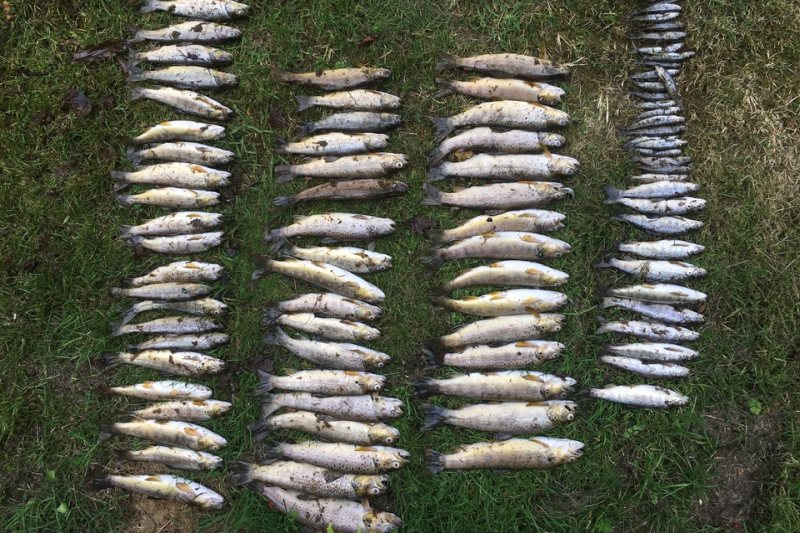
The digestate made its way to the river after heavy rain washed it off the land into a tributary of the River Mole.
Alun and Amanda Sing are directors of A J Sing and Son Ltd, which grows crops to feed the anaerobic digestion plant operated nearby by Condate Biogas Ltd.
The resulting digestate is then tankered back to Pillavins Farm by Condate, where it is stored in a lagoon.
Pillavins Farm lies on the south side of the A361 North Devon link road near South Molton and at the time of the incident digestate was being spread on fields lying more than 1km away from the lagoon, on the opposite site of the road.
To reach the fields, pipework took the digestate through a rainwater culvert under the A361 and pumps were used to maintain the pressure needed to push the digestate the long distance.
The pipework was left in place for several days and Mr Adams, the company’s sole permanent employee, restarted the spreading operation on 30 July, assisted by two self-employed sub-contractors.
The court heard that A J Sing and Son Ltd were negligent in that they did not have systems in place to ensure that the proper checks had been made and to ensure that spills were properly dealt with.
The farming company was £2,000 and ordered to pay £9,836 in costs.
Environment officer Nicola Rumsey it was a 'truly shocking' fish kill as it was one of the largest ever recorded in Devon and Cornwall.
“The discharge of digestate into the river had a devastating effect on the fish population. It may take a number of years for the fish population to fully recover," she said.
“Great care must be taken when applying digestate to land. Simple observation of the weather forecast and the forecast of rain should have been enough to halt the digestate spreading."