




Farmland market shows 'more volatility than ever before'

Price variations in the farmland market are widening even at a very local level, as agricultural commodity markets remain weak and buyers show more price sensitivity.
Mark McAndrew, head of national farm sales at Strutt & Parker, said the land market was showing more volatility within regions than in the past, which made it vital that sellers adopted the right pricing strategy.
“There is a massive range of prices depending on what the land is, where it is and size. A year ago it was the larger blocks of land which were most in demand, but in some regions we are now seeing smaller 50-acre blocks securing the higher premiums.
“Location is becoming increasingly important as lifestyle and tax-driven buyers become key to a premium bid. Meanwhile, farmers are looking much more closely at what they might need to invest in land and therefore factoring that more accurately into what they are prepared to bid.”
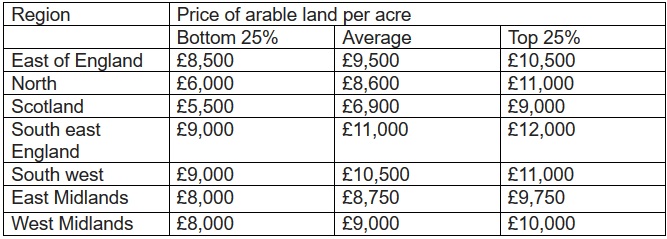
Mr McAndrew said while the upcoming EU referendum had caused uncertainty, with less land coming to the market in recent months, average prices had remained relatively stable.
“Many of these sales were agreed before the date of the referendum was announced, however, it does feel like the threat of Brexit is having less of an impact on land values than some commentators had predicted,” he said.
“There may be some buyers and sellers holding off until they find out the outcome in June, but I don’t foresee a significant drop in land values and it will continue to remain a good investment.”
According to Strutt & Parker’s Farmland Database, the average price of arable land in England sold during the first quarter of 2016 was £9,668/acre, which was down 3% from the December 2015 figure, but higher than the average price in Q1 of 2015.
Mr McAndrew said with buyers across the country becoming increasingly discerning it was important to have a sensible guide price, which reflected local circumstances.
“You can’t always follow average prices for a region, as prices can vary considerably within a very small area. This means it is vital to get honest, expert advice on what is selling in your area and how to maximise the potential of any sale.”
The most successful sales tend to come where a reasonable guide price is set, which encourages viewings and competing bids.
Sellers should also take advice on whether lotting might be appropriate as it can increase competition by attracting buyers who may be interested in individual lots.
Regional insight
Scotland: “Buyers are being more price sensitive in Scotland due to the delay in their Basic Payments and poorer commodity prices. However, prime arable farms remain in short supply and buyers are prepared to pay a premium for quality offerings. There is a limited number of buyers for smaller, livestock units, but demand is there for extensive, well-balanced stock farms.” James Butler, Associate, Edinburgh office
South East England: “Demand in the South-East England over the first few months of 2016 has been driven by private individuals looking for either an investment or a lifestyle purchase. Those looking at land as an investment are typically also looking for scale. Looking forward, bare arable land and residential farms are most in demand and, while buyers are being more sensitive to price, demand should still outstrip supply.” Matt Sudlow, Partner in charge of south east region
South West England: “Buyers with rollover funds from development continue to play an important role in the land market in South-West England, generating strong demand for commercial farms where the residential element is low. Local demand is becoming the biggest factor in determining price. For example, small blocks of arable land are more difficult to sell in this area unless there are strong local buyers looking to expand.” Charlie Evans, Partner, Salisbury office
North of England: “Quality, not quantity is the driver in the market at the moment and quality will still sell well. Remote farms or estates with very large houses that need work are more difficult to sell, as buyers are looking closely at what they need to invest to bring things up to speed and farmers are being cautious about servicing debt.” Will Parry, Partner, Harrogate office
East of England: “During the first quarter of the year there has been very little land available, to some large degree due to the uncertainty around the UK’s membership of the EU. For blocks of land that have come on the market, location and right pricing is key and investors from outside the farming industry are playing a bigger role in the market as buyers.” Michael Fiddes, head of estates and farm agency department
East Midlands: “Farmers are becoming more discerning and specific about location and quality of land. There is also a continuing demand from non-farming money for land with long-term development and capital growth prospects.” Sam Holt, Surveyor, Stamford office.
West Midlands: “Rollover buyers with development money are common in this area, especially along the M40 corridor. The number of lifestyle buyers is also on the rise. I expect the market in the West Midlands to continue on a slow upward trend. Supply is tight which maintains competition for anything that comes up in this region.” Mark Wiggin, Partner, Ludlow office.




