




Fly-tipping now a national criminal enterprise, report warns
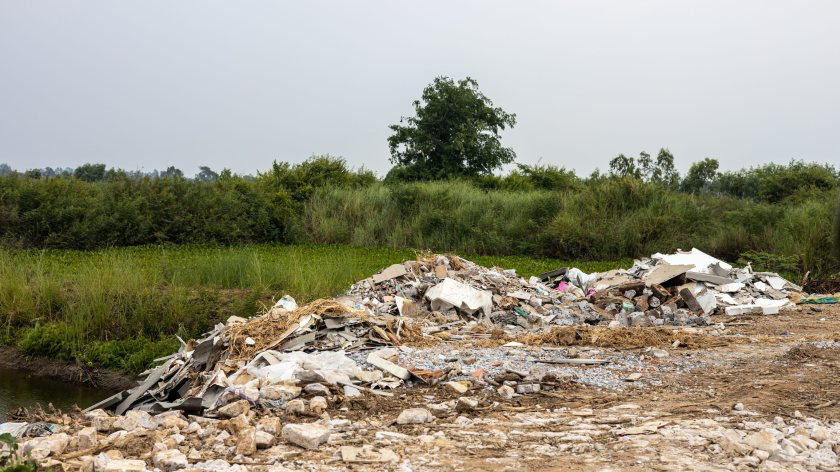
Fly-tipping has become a large-scale criminal enterprise, with weak enforcement leaving farmers, landowners and rural businesses to pay the price, a major new report has warned.
Future Countryside and the National Rural Crime Network said waste crime was devastating rural communities, damaging the environment and costing the UK economy hundreds of millions of pounds each year.
Their report, Breaking the Cycle: Tackling Fly-Tipping and Waste Crime – A Roadmap for Reform, argues that the current system is fragmented, inconsistent and failing victims.
Official figures show local authorities in England dealt with more than 1.26 million fly-tipping incidents in 2024-25, up 9% on the previous year.
But the report warns the true scale is likely to be far higher, as incidents on private land, large-scale illegal dumping handled by the Environment Agency and many unreported cases are excluded from national data.
Only around 31% of recorded incidents are investigated, while more than half of those investigations result in no further action.
In 2024-25, there were just 13 custodial sentences for fly-tipping offences across England.
The report says farmers, landowners and rural businesses are being unfairly burdened with the cost of removing illegally dumped waste.
Many victims can be left facing bills running into thousands of pounds, despite being targeted by criminals.
The report warns that organised criminal gangs are increasingly involved in waste crime, exploiting weak regulation and patchy enforcement to generate substantial illegal profits.
At least 11 major illegal waste “super-sites” have been identified across England.
These include one site in Cheshire containing an estimated 280,000 tonnes of waste.
The report will be formally launched at Future Countryside at Raby Castle on Tuesday 2 June.
The launch will include a discussion on waste crime led by broadcaster Kirstie Allsopp, who also contributed the foreword to the report.
Future Countryside and the National Rural Crime Network are calling for a single national reporting system for waste crime incidents.
They also want stronger regulation of waste carriers and brokers, better intelligence-sharing between agencies and tougher action against organised criminal networks.
The report calls for clearer national accountability for local authority enforcement activity and reforms to stop victims bearing clean-up costs.
It also proposes a comprehensive national dataset covering all fly-tipping and waste crime incidents, including those on private land.
A new Waste Crime (Prevention) Act is also proposed to bring a range of reforms together under a single legislative framework.
Tim Passmore, chair of the National Rural Crime Network, said the report exposed a failing system.
“Waste crime and fly-tipping is not low-level nuisance offending – it is serious, organised criminality that is damaging our environment, hitting rural communities hard and leaving innocent victims to foot the bill,” he said.
Mr Passmore said criminals knew “the risks are low and the rewards are high”.
“That has to change,” he said.
“We need tougher enforcement, sharper accountability and a system that finally treats waste crime and fly-tipping with the seriousness it deserves.”
Julian Glover, co-founder of Future Countryside, said fly-tipping had moved beyond being a minor environmental issue.
“Fly-tipping is no longer a simple environmental nuisance,” he said.
“It has become a serious criminal enterprise which blights communities, harms nature and places victims under unacceptable financial pressure.”
He said rural communities were too often left to shoulder the cost while offenders operated “with impunity”.
Mr Glover said the report set out a practical roadmap for reform, but warned that existing powers were not being used consistently.
“The laws already exist in many areas, but enforcement is inconsistent, accountability is ill-defined and organised criminals are exploiting the gaps,” he said.
“Without decisive action, the problem will continue to grow.”
The report draws on official statistics, industry evidence, academic research and testimony from across the rural sector.
Future Countryside and the NRCN said political attention on waste crime had increased following the government’s Waste Crime Action Plan and an ongoing House of Lords inquiry.
The National Rural Crime Network, which includes rural organisations such as the NFU, Crimestoppers and the Countryside Alliance, is calling for a more coordinated national response.
It said ministers, regulators, police forces, local authorities and the Environment Agency must work together to tackle the growing threat.




