




Free range – a good investment and a good life!
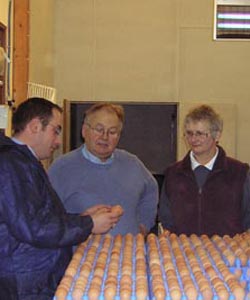
Free range egg production has been one of the most enjoyable agricultural activities undertaken by Philip and Christine Greenacre of Park Farm, Syleham, near Diss on the Norfolk/ Suffolk border. But it was only by chance that the Greenacres became involved in free range production. A neighbour back in 2002 asked Philip if he could get some information about free range egg production off the internet. Unlike today the arable side of the business was suffering from low prices. When Philip and Christine examined the information they had taken off the internet they decided to investigate even further making contact with Bowlers and Deans (now Noble Foods). They soon realised that moving into free range production was the ideal opportunity for them to diversify and improve the farm income.
During 2003 planning permission was sought for a 12,000 bird unit, which came on stream early in 2004. The unit was a naturally ventilated Harlow house kitted out with Potter nests, slats, drinkers and feeders. The success of the first flock persuaded the Greenacres to invest further and in 2005 a second, 8000 bird house came into production again supplied by Harlow with equipment from Potters. In the egg take off and packing area Staalkat egg packers were installed along with Rotem computerised management aids, giving data on cumulative/daily feed intake, water intake and bird weight. Accommodation for a further 1800 birds came in 2006 in the form of a mobile Mcgregor Polytunnel, again fitted with Potters equipment.
The two larger houses are currently stocked with ISA Warren and ISABROWN birds reared by Potters. This followed a successful trial with ISABROWN layers in the polytunnel which Philip described as a 'text book flock'.
ISABROWN mobile trial flock
Peak production 94.3% @28 weeks
90% production + 23 weeks
Hen housed average projected to 72 weeks 315 (+3% over target)
Egg weight:
25 weeks 62.3g
30 weeks 64.9g
45 weeks 66.3g
50 weeks 66.5g
Philip decided to stock the 8,000-bird house with ISABROWN based on the birds prolific egg production and feed conversion. In the 12,000 bird house he opted for the ISA Warren as it produced a slightly bigger egg than the ISABROWN and had been bred to perform on free range having excellent feather cover throughout lay, hardy and with good liveability.
"By having the two breeds we get the best of both worlds in terms of production economics," explained Philip.
At 37 weeks of age feed consumption for the ISA Warren was around 138g/bird/day compared to 132g for the ISABROWN. Both feed intakes were higher than expected simply due to the fact that both flocks had not been let out to range due to an outbreak of Avian influenza in the area. Prior to being shut in feed intake was almost 4g a day less for both breeds.
Flock performance to 37 weeks
ISABROWN
Liveability 98.2%
Peak production 93.6%
Hen housed average 104.5
Average egg weight:
24 weeks 59.3g
30 weeks 62.0g
37 weeks 65.1g
ISA Warren
Liveability 98.8%
Peak production 93.4%
Hen housed average 105.7
Average egg weight:
25 weeks 60.0g
30 weeks 62.5g
37 weeks 66.4g
Flock performance from both houses is well on target a particular feature being the very low percentage of seconds and floor eggs. This is not surprising when there is friendly rivalry between the husband and wife team. Philip manages the ISABROWN birds while Christine takes charge of the ISA Warren, both ably assisted by stockmen Lenny and Paul. Already the orders for ISABROWN and ISA Warren pullets have been placed for the next intake.
Asked about the low number of floor eggs, 26 from the 12000 bird unit on the day of our visit, Jason Cooper of Tom Barron Independent Hatcheries explained that the key was the attention to detail with regard to the management of the nests as the birds came into lay coupled with regular walking of the flock.
As soon as the first egg appears the nest boxes are opened an hour before lights on and closed two hours prior to lights out. After the next increase in light stimulation the nest lights also come on one hour before lights on.
Another point Jason makes is that there is a difference in the two birds in so much that the ISA Warren is approximately 100g heavier. At 18/19 weeks ISA Warren flocks should average 1650-1700g at which time they should receive light stimulation when trying to achieve a higher egg weight profile. In the case of the ISABROWN the 18/19 week bodyweight should be 1550-1600g. By ensuring light stimulation is linked to the correct bodyweight then both breeds are capable of producing 70-75% large and extra large eggs, maintaining excellent egg quality and low seconds.
One feature of the eggs as they roll out of the nests is their cleanliness. Albeit this was partly due to the fact that the birds were not allowed to range. But even when the birds are ranging and the weather is foul there are very few dirty eggs to deal with. This is due to the fact that when birds return into the house from the range they have to walk over a series of wire frames and then an area of stone which effectively ensures they have clean feet on re-entering the house.
"Our birds have the cleanest feet in the area," said Philip.
Hygiene and biosecurity are taken very seriously to the extent that only one vehicle, the egg collection lorry, ever enters the poultry unit and then having driven through a purpose built wheel dip. The only other vehicle is the tractor and bulk feed unit which Philip uses to collect feed direct from the local BOCM PAULS' mill a few miles up the road at Burston near Diss. The feed is made to a specification laid down by Marks & Spencer and consists of some five diets, a selection of which are phase fed throughout lay, the diets being changed in line with egg numbers, egg size and feed intake. On the current flock three of these diets will be used.
The eggs are supplied to Noble Foods being produced to Marks & Spencer standards. The eggs also meet the requirements for Woodland Eggs following the planting of 5,500 English native
trees. Some of the eggs are supplied to the Norwich City Football Club's restaurants.
Philip believes the future for free range production is bright, 'not only is it a good investment but a good life'.
However there are challenges for the future not least the control of Avian influenza, feed price control and the increasing problem obtaining planning permission for new units. His parting shot to the new owners of Park Farm, Michael and Angela Wright is a simple one, ' look after the birds and they will look after you.




