




Growers urged not to leave black-grass problems
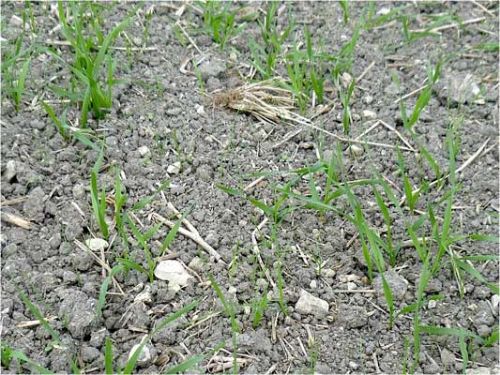
Winter wheat growers are facing some unusually big black-grass plants and populations this autumn, after crops have been established early and recent warm temperatures have allowed the weed to germinate rapidly, a crop protection technical manager is warning.
Left unchecked, these could store up major losses if left until spring, he stresses, not least because plants could become too big for herbicides to fully control.
"In some cases we’ve seen black-grass with two leaves or more emerging even after fairly robust pre-emergence treatments," says Syngenta field technical manager Iain Hamilton. "It seems that black-grass has been able to germinate from deeper where moisture was available earlier.
"The risk is that if allowed to grow through the winter, this will be extremely difficult to control by the spring. A similar thing happened in autumn 2009, when there were some terrible black-grass problems in spring and summer 2010."
The key, suggests Mr Hamilton, will be to get on top of the increased burden of black-grass promptly and firmly to avoid it slipping through the net.
Where significant black-grass is emerging, he believes this could well prompt growers to apply their post-emergence mesosulfuron/iodosulfuron herbicide against it in autumn – rather than waiting until spring – and in these situations he urges adding 3 l/ha of Defy to it to add extra activity, provided that Defy hasn’t already been applied.
This guidance follows independent trials conducted by the Association of Independent Crop Consultants (AICC) for Syngenta in 2010 which showed adding Defy to mesosulfuron/iodosulfuron boosted black-grass control by 15% on average, notes Mr Hamilton, compared with around 5% where pendimethalin was added to mesosulfuron/iodosulfuron. In both cases, he says, this followed a pre-emergence treatment having been applied.
"Removing black-grass in autumn removes the yield penalty from having it competing with the crop over winter. Leaving black-grass unchecked over winter can result in 35% less yield and fewer wheat tillers, and there is increased risk of selecting for resistant weeds with increasing weed size.
"Last autumn, we saw excellent activity from October application of 0.4 kg/ha mesosulfuron/iodosulfuron + 3 l/ha Defy + adjuvant onto strong black-grass. The treatment was already taking effect in November and by February a high level of final control was observed."




