




How clean is your feed?
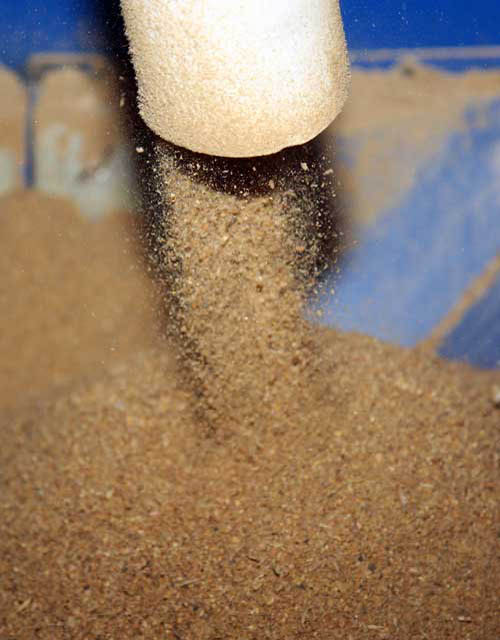
The following is an extract from the Ranger magazine. Published by the British Free Range Egg Producers Association. To enquire about membership visit www.theranger.co.uk
The new raft of zoonosis regulations, and in particular the requirement to carry out environmental testing at regular intervals, has made Free Range producers more keenly aware than ever of the need to be constantly on their guard against Salmonella. The presence of vermin, contact with wild birds and contaminated drinking water are known to be potential routes for infection of a flock, and producers have responded accordingly with strict hygiene routines and strategies for rodent control. However, another possible and perhaps lesser-known route is the risk of introducing Salmonella onto a farm via the feed.
WHAT IS THE RISK OF FEED CONTAMINATION?
The precise level of risk posed by feed contamination is difficult to assess; opinions amongst the experts are somewhat divided; but the consensus is that there is a degree of risk, however small, and producers must decide how to address it. Mark Williams, Chief Executive of the BEIC, states: "Salmonella and other organisms can gain entry to poultry farms from a variety of entry points, and feed is no exception."
He adds that advice from Rob Davies at Veterinary Laboratories Agency (VLA) is that some ingredients such as soya, rape and linseed meal can be contaminated with exotic Salmonella in the oil extraction plants. However, Salmonella enteritidis (Se) and Salmonella typhimurium (St) are rarely found in these plants. Grain can become contaminated with wildlife strains including St if there is a local source of St for the wildlife, for example infected cattle or pigs. There are also some wild bird St phage types which may occasionally appear in grain. Se in feed is now rare as the cause has been removed – Se has been cleared from broiler flocks and there is now no Se positive litter being spread onto land.
MEASURES ALREADY IN PLACE
Measures are already in place in the UK to protect against feed contamination. "There are a number of DEFRA Codes of Practice designed to help protect both raw materials and finished feed from the risk of Salmonella contamination," Mark explained. "In addition, the Lion Code of Practice requires all feed to be produced to UFAS standards." UFAS (Universal Food Assurance Scheme) and its sister scheme FEMAS (Feed Materials Assurance Scheme) are voluntary Codes of Practice for feed compounders and merchants, covering the production and delivery of compound feeds and the supply of feed materials to the farm. All UK feed producers and raw material suppliers accredited through the UFAS/FEMAS Quality Assurance schemes have active anti-salmonella programmes in the feedmills and stores.
Murray Hyden, a gut microbiologist employed as Chief Technical Officer at Agil, points to DEFRA’s annual report on ’Salmonella in Livestock Production’ which shows feed to be a very low risk factor, with less than 1% of poultry meal feeds showing Salmonella positive. Murray says: "People often tend to blame feed, but generally speaking this is not the principal source of Salmonella. More likely sources include drinking water, mites, rodents and wild birds. A recent survey carried out in the US also put feed very low on the list. But producers cannot dismiss it altogether, because it will always be a potential threat."
However, Paul Forster, of Optivite, is less sure that the full extent of the problem has been uncovered by the sampling procedures that are used. "Feed is definitely a potential route for the transference of Salmonella to poultry," he says. "Care and attention is paid throughout the supply chain to protect feed from Salmonella; stores and feed mills are regulated and adhere to strict Codes of Practice. But despite due diligence, it is still possible for feed to be contaminated by wild birds and vermin. And although raw material is sampled and tested, it simply is not possible to test every grain or every gram. The absence of Salmonella in the samples is not in itself conclusive." He points out, too, that contamination of feed can also occur at the farm. Feed tracks have to be open to give birds access to feed, and that puts the feed at risk of contamination by vermin or flies. "Farmers need to do their bit by exercising strict vermin and fly control," Paul advises.
If even the tiniest amount of Salmonella is ingested, this can potentially multiply very rapidly inside the bird’s digestive system, and the infected faeces will soon give rise to a high environmental count.
ONGOING RESEARCH BY DEFRA
More data on the extent of the problem should be available soon, as a separate DEFRA project is currently looking at this very issue. The project, ’A comprehensive review of the treatment of feeding stuffs related to the control of Salmonella in layer flocks (OZ0329)’ began in August 2007 and is due to complete at the end of May 2008. It set out ’to analyse the contribution made by Salmonella in feed to this problem, primarily in respect of egg-producing flock infections, and to investigate the reasons for feed contamination.’ The review report is expected to contain recommendations for ’practical and costed interventions in the animal feedstuffs chain to reduce the risk of contamination’. The findings of this investigation will make interesting reading. Full details of the scope of the project can be found online at http://www2.defra.gov.uk/research/Project_Data/More.asp?I=OZ0329&M=CFO&V=VLA
THE ROLE OF FEED ADDITIVES
Feed contamination is by no means a new issue; indeed, this problem had already long been recognised, and feed additives to inhibit Salmonella had already been developed, before Edwina Curry’s infamous contribution to the topic. Theoretically, antibiotics could be added to feed to kill any Salmonella bacteria, but in practice this is unacceptable because of concerns over antibiotic resistance transfer. Organic acids are well known for their anti-bacterial properties, and these remain the basis of leading anti-salmonella feed additives.
Feed additives can be used in conjunction with other methods to combat Salmonella throughout the production chain. One approach is to focus not just on killing Salmonella in the feed, but on treating the bird. As Murray Hyden explains: "In nature, animals protect themselves from Salmonella infection by having a strong immune system and a healthy gut microflora." Competitive Exclusion is the one-time bacterial inoculation of newly hatched chicks to give them all the healthy bacteria found in an adult bird. It is possible to boost the bird’s resistance to Salmonella so that Salmonella bacteria, from whatever source, do not multiply inside its digestive system. This can be done by lowering the pH value (i.e. raising the level of acidity) in the gut, which leads to the production of lactic acid, thus producing an environment where Salmonella cannot thrive.
FEED ADDITIVES AVAILABLE
The following are just some of the feed additives on the market. Before using any product, producers should check that it carries the accreditations and approvals required by their business.
Salgard (Optivite)
Salgard’s formula is based on organic acids. It is added to feed and works in a natural, non-pharmaceutical way to kill bacteria. Developed in the 1990s initially to combat Salmonella contamination of poultry feeds, Salgard has since been further developed to provide a complete antibacterial package that has been proven effective against a range of problem bacteria. It allows beneficial bacteria (e.g. Lactobacillus, Bacteriodes) to proliferate to encourage a healthy microfloral population in the gut. Salgard can be added to raw materials or during feed manufacture and will remain effective in the feed to give protection right through to bird consumption.
Paul Forster commented: "This is a well tried and te




