

Northern Ireland unveils nature recovery plan amid farming concerns
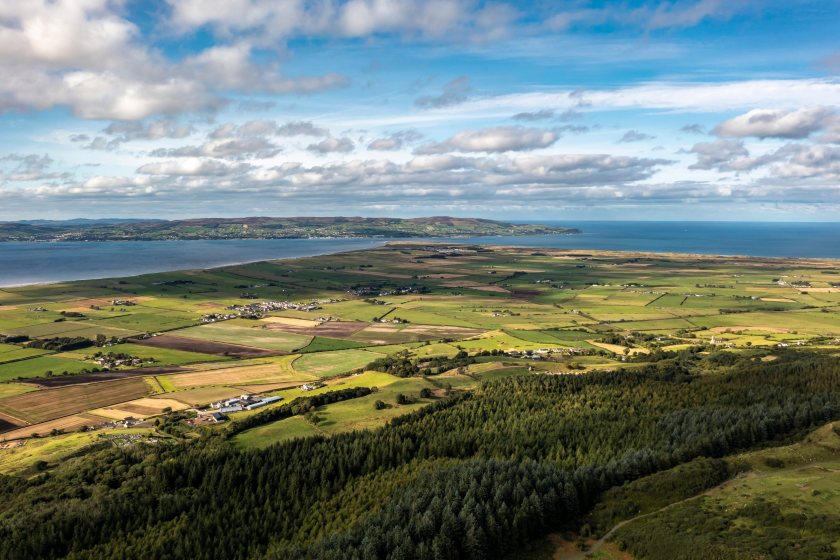
Farmers will play a major role in restoring Northern Ireland's countryside under a new government strategy, but concerns remain over funding and the potential impact on food production.
The Department of Agriculture, Environment and Rural Affairs (DAERA) launched its Nature Recovery Strategy to 2032 on Tuesday 27 October, setting out plans to restore habitats, reverse biodiversity decline and improve the management of protected areas.
Agriculture and Environment Minister Andrew Muir said delivering the strategy would require significant investment and cooperation between government, farmers, land managers and environmental organisations.
The plans support the international ambition to conserve and effectively manage 30% of land and inland waters, alongside 30% of marine and coastal areas, for nature by 2030.
However, government figures show that just 9.9% of Northern Ireland's terrestrial land area is currently designated as protected.
Around 38% of marine waters are covered by protected designations, although DAERA acknowledges that some sites need substantial ecological improvements.
Launching the strategy on the Belfast Hills, Mr Muir stressed that restoring nature would require more than designating additional protected areas.
"Our task is not simply to draw lines on a map," he said.
The strategy contains five objectives aimed at tackling biodiversity loss, improving habitats and coordinating environmental action across Northern Ireland.
Restoration priorities include peatlands, wetlands, rivers, woodlands and species-rich grasslands.
For the agricultural sector, a central question is how these ambitions will be delivered alongside food production.
The Ulster Farmers' Union (UFU) has expressed reservations about the strategy, warning that farming must not be overlooked when setting environmental priorities.
Deputy president Glenn Cuddy said the organisation remained sceptical about aspects of the proposals and stressed that farmers had been managing the countryside for generations.
"We have always been the guardians of the countryside and for nature too," he said.
The concerns come as some farmers continue to experience difficulties accessing existing environmental support.
The UFU has previously highlighted problems with mapping requirements under DAERA's Farming with Nature Transition Scheme, with some productive arable land excluded from particular funding options.
The union has called for greater clarity and rules that recognise the practical realities of agricultural production.
Meanwhile, DAERA's Sustainable Agriculture Programme is already providing financial support for environmental improvements on farms.
The first year of the Farming with Nature Transition Scheme saw 489 farm businesses qualify for funding, with £2.7 million released in June 2026.
The scheme supported the planting of more than 134 kilometres of hedgerows and 28 acres of trees.
Farmers also established over 35 kilometres of watercourse buffer strips, alongside winter cover crops and retained stubble to support biodiversity.
Further opportunities are planned through the Farming with Nature Landscape Projects Scheme, which opens for applications on 9 November.
The programme aims to support up to 10 large-scale restoration projects across Northern Ireland, each potentially involving as many as 50 farmers and land managers.
Unlike measures focused on individual holdings, the scheme will encourage neighbouring farms to work together to restore habitats and improve biodiversity across larger areas.
DAERA has outlined proposed funding of £9 million across the initial projects, including £4 million for project development and £5 million for practical habitat restoration.
Additional participation payments are also proposed for farmers taking part in training and environmental monitoring.
Applications are scheduled to close on 4 December 2026.
However, the proposed £9 million relates specifically to the landscape projects scheme, rather than the overall cost of delivering Northern Ireland's new nature recovery strategy.
DAERA has not announced a single overall funding allocation covering implementation through to 2032.
Mr Muir acknowledged that substantial long-term investment would be required, with public funding alone potentially insufficient.
He said "a biodiversity finance plan must be developed" to secure government and private investment for restoration.
The minister also confirmed plans to establish a Nature Recovery Forum, bringing together stakeholders to help coordinate delivery.
However, detailed arrangements for the forum, including the representation of farming interests, have yet to be confirmed.
Further decisions are also needed on legally binding nature restoration targets.
Mr Muir acknowledged that limited time remained in the current Assembly mandate, with work on statutory restoration targets expected to continue during the next mandate.
Environmental organisations have welcomed the strategy but warned that meaningful improvements must follow.
Ulster Wildlife said Northern Ireland's habitats remain under considerable pressure, with one in nine species threatened with extinction.
Peter McEvoy, the charity's director of land management, welcomed the publication but warned that "the real test is what happens next".
He called for measurable outcomes, clear targets, defined responsibilities and sustained investment to ensure restoration delivers lasting results.
The organisation believes restoring peatlands, rivers, wetlands and woodlands could improve water quality, reduce flood risks and support wildlife.
It also stressed that cooperation with farmers and land managers would be essential.
Although the strategy supports the international ambition to conserve and manage 30% of land and inland waters, this does not mean that 30% of farmland will automatically be removed from agricultural production.
Environmental improvements can be delivered alongside farming, although the implications for individual businesses will depend on how future targets and support schemes are developed.
For farmers, the main questions remain whether sufficient funding will be available, how future requirements will affect productive land and whether environmental commitments can be delivered without placing additional pressure on businesses.
With new funding opportunities opening in November, attention will now turn to how DAERA translates its nature recovery ambitions into practical action.