




Painsford Farm - Where the birds do the talking!
It is a simple philosophy when it comes to successful management of free range layer flocks at Peter Foster’s unit at Painsford Farm near Totnes in Devon he simply ’lets the birds do the talking’. Having been involved in poultry production since the mid 1960’s it is not surprising that Mr Foster has amassed a great deal of expertise when it comes to flock management. However, as he points out ’ no matter how experienced a flock manger is the first rule is to recognise that every flock, irrespective of the breed, is different’.
Flock management he says is obviously critical which means spending time with the birds and checking performance parameters on a daily basis. This means not just egg numbers but daily feed intake, egg size, shell quality and most important bird behaviour. Equally important according to Mr Foster is to maintain close links with suppliers and the packing station. "I look at the business of egg production as a team game with everyone from chick and pullet supplier to feed and packer contributing to the well being of the flocks and the maintenance of high performance," said Mr Foster.
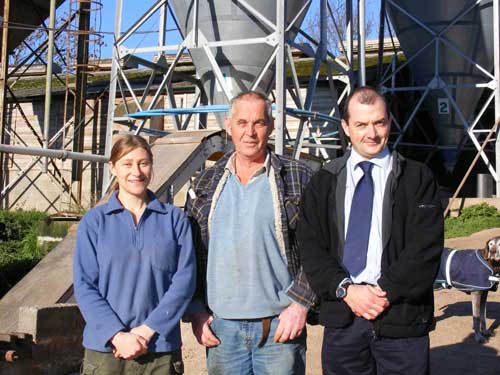
This close liaison with suppliers was evident at the time of our visit when Robin Loughrey of Tom Barron Independent Hatcheries was at the unit to check weigh the latest 9,000 flock of ISA WARREN. Robin explained that he checks weighs flocks from housing every week to 25/26 weeks of age to ensure bodyweight progression is maintained through peak production. The current flock was already at 94% production, at 24 weeks of age, well on the way to matching the previous flock performances of 315 and 308 eggs a bird on 128 grams of feed per day.
When Mr Foster first started with poultry it was with broiler breeder flocks supplying hatching eggs to Lloyd Maunder. This was followed by a number of years growing broilers and then in 2001 he moved into barn egg production converting the two 1960’s Harlow house adding Vencomatic nests and upgrading drinker and feeder lines. The eggs were supplied to local packer Freshlay. Like many who had ventured into barn egg production Mr Foster recognised that free range egg production would be more profitable and so in 2003 the houses were adapted for free range egg production through the addition of pop holes down one side of each house.
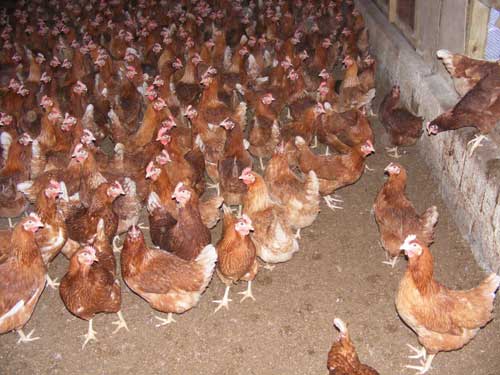
Today five years on Peter Foster and his farm manager Anna Cutler can reflect on how they have developed a successful formula to ensure optimum performance from the flocks. Anna herself has wide experience in free range production as she combines managing the unit with working part time for Humphrey Feeds. There are two houses on the unit holding 8,000 and 9,000 birds respectively supplying eggs to packers Fridays. Since the last flock a Prinzen egg conveyor has been installed to transfer eggs from house 1 to the Prinzen egg packer in house 2.
The first problem encountered following the house conversions was with regard to the ventilation system. The old Harlow houses had side extraction fans with air entering via ridge inlets. While this had worked well in the past it posed problems for the free range flocks as there was uneven air flow in the house resulting in hot and cold spots and stale air in parts of the houses.
Following advice a 48 inch extractor fan was installed in the far gable wall to pull air down the length of each house. This partly solved the problem but when the fans and inlets were on sequential control air movement still posed a problem in parts of the houses. Eventually this was put down to the solid partitions in the houses which forced air over the birds rather than onto them. The partitions were removed and replaced with wire mesh, which allowed air to flow within the houses much more freely.
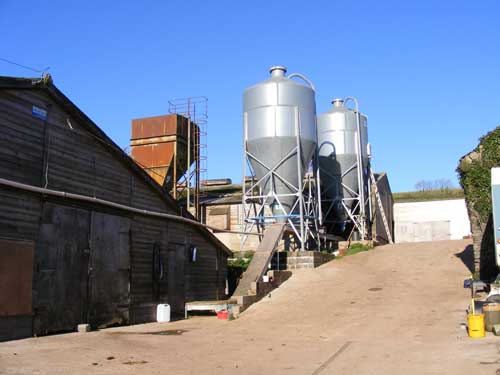
For most of the time the evolved ventilation system worked well but at times when the system was operating a minimum settings both Peter and Anna recognised that there was insufficient airflow and a build up of stale air. The solution was the installation of a 24 inch fan suspended over the first ridge inlet. The fan operates 24 hours a day pulling clean fresh air into the houses and ensuring air quality is maintained.
But having achieved what is an optimum environment for the birds is only part of the story as Peter and Anna explained. Successful production starts with the rearing of the birds. Pullets are supplied by local rearer Richard Frankpitt and are inspected by Anna every two weeks throughout rearing until the birds are transferred at 16 weeks. All the birds are floor reared with A-frames to encourage perching.
"It is essential producers recognise that transfer is a major stress on the birds which can result in too much weight loss and a drop in appetite thereby compromising the birds metabolism at a critical time," explained Anna.
To reduce the effect of the stress the birds given a course of Spectrum multi-vitamins starting five days before they are moved and continuing for five days after the move. At the same time the flocks are wormed. Thereafter flocks are only wormed if faecal samples show high worm counts.
Both Peter and Anna believe the use of multi-vitamins is important. At the first signs of any stress, disease or drop in feed intake the first measure taken is to administer multi-vitamins whilst the problem is being identified. In addition multi-vitamins are used whenever there is a change in feed.
"To often producers loose valuable production waiting for test results when the addition of extra vitamins will assist the birds metabolism before a specific treatment can be applied. The use of multi-vitamins is a valuable tool in aiding recovery and minimising production losses," said Anna.
To boost the ability of the bird’s digestive system gut health is bolstered through the administration of the probiotic Aviguard and the inclusion of Vetmosan, a mannan-oligosaccharide, in the feed supplied by Humphrey Feeds.
On arrival at the unit birds are placed on the slatted area adjacent to the double tier side belt Vencomatic nests. The nests remain closed until the first 2 eggs laid are spotted at which time the nests are opened. The nests then open automatically 1½ hours before lights on and close at 3.30 in the afternoon.
The lighting programme is equally simple birds being on 10 hours a day at transfer which is then gradually increased to 14 hours maximum. Time clocks are based on BST through out the year effectively meaning that lights come on at 8.00am and off at 10.00pm in summer and 7.00am and 9.00pm in winter.
As to the future Mr Peter Foster like many other producers is concerned as to the effect of the cage ban in 2012.
"If the industry is not careful it will open the flood gates for imported eggs which if not controlled could undermine the UK free range egg market," says Mr Foster.




