




Should on-farm stamping be left to cage producers?
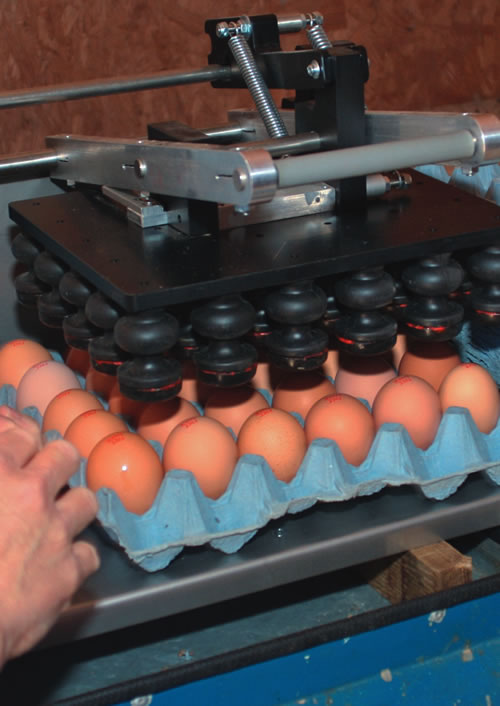
Scottish egg producer John Campbell says on-farm egg stamping is an unnecessary cost for free range producers.
John, whose Peebles-based Glenrath Eggs is Scotland’s biggest egg producer, is involved in both cage and free range production. He says it is right that on-farm stamping should be introduced for cage systems to help prevent egg fraud. But he says introducing on-farm stamping for free range producers is expensive and unnecessary because free range eggs are not the problem when it comes to fraud.
"I believe it is a waste of time stamping free range eggs. Cage eggs need to be stamped on the farm because it is cage eggs that are going to be used to cheat. No-one is going to pass free range eggs off as something else so there is no point having free range producers stamping their eggs on the farm."
John said that at Glenrath on-farm stamping was used for cage flocks but not free range. He said he had spoken to customers about the issue and they agreed with him that on-farm stamping for free range flocks was unnecessary.

Lion code subscribers will discuss on-farm marking at a meeting later this month. It is expected that at the meeting on September 29 subscribers will agree to introduce on-farm marking for cage eggs as part of the Lion code.
"There was a sub group set up to look at on-farm marking. I think the decision will be to go for on-farm marking. The industry view is that it is probably inevitable," said Andrew Joret, Noble Foods technical director. He said cage eggs would be first – probably by January next year under the Lion code - but others would follow. He said the burger chain McDonald’s had already incorporated on-farm stamping into its specifications. The supermarket chain Morrison was doing so, too.
Andrew said Noble would be paying for the equipment on suppliers’ farms. He said suppliers with farm packers presented no problem as the printer would simply bolt onto the machine. Noble was conducting trials on farms without packers as they were the ones where there was potentially more work involved.
He said Noble would be rolling out on-farm stamping to all its suppliers, both cage and free range producers. The cage producers would be first – in order to comply with the anticipated Lion decision. It would probably take about 12 months to roll out on-farm marking to all suppliers, he said.
Andrew said that stamps were available that could mark an egg with the code around the Lion mark. He said that although it would not be used at this stage, it was a possibility in the future. "It could provide a strong marketing message to open a box and see six lions on the top of the eggs."
BFREPA chairman Tom Vesey said he understood John Campbells’s argument, although his own view was that all producers should be involved in on-farm marking. "I think everybody should mark on farm. It is certainly not the complete answer to fraud but it is another weapon in the armoury.
"I can see John Campbell’s point of view – that it will be expensive – and it is a very valid argument, but from a PR and anti-fraud point of view I think we should do it. I know it is another thing for a producer to do and it is a nuisance but I am still in favour of it. That is my personal view, although there will be others who think differently and I can see that it would be more of a problem for the smaller producers." He said that as a producer with 16,000 birds he was able to put a printer on his packing machine, but for small producers using a manual system the introduction of on-farm printing could be more of an issue.
Free range producer John Widdowson carried out some early trials on on-farm stamping when BFREPA decided to look into what problems could be encountered by its introduction. John used a manual system. He said carrying out stamping manually was possible, although it did cause extra work and there was an added cost for farmers. "It was manageable when I tried it. It did involve extra work and there was what I would describe as a not insignificant cost, but my conclusion was that it was ’do-able’," he said. "If you have 16,000 birds then you can justify automated machinery. If you have 4,000 birds, it will involve some form of manual stamping."
The packing company that pioneered on-farm egg stamping was Oakland Farm Eggs. Oakland became the first packer to commit to stamping all eggs on farm and won recognition for its work when Elwyn Griffiths collected the Breakthrough of the Year award at last year’s BFREPA conference. "Whatever the egg is, if the farmer stamps it then it is what it is when it leaves the farm. Farmers are the most honest people to do this. There are more rogue traders and retailers than farmers," said Elwyn. "In our view, any unmarked egg is a loose cannon."
Oakland has paid for the stamping units to be installed at each of its suppliers’ units, and is also financing consumables such as ink. The company said it felt it was important to support producers and to protect the industry against foreign imports as much as it could - ink printing at farm level offered another important tool to ensure full traceability of every egg that came through the packing centre. It also gave consumers confidence that they knew where their eggs came from.
Elwyn said Oakland was using equipment from two companies for the on-farm marking. There were systems for automated operations and there were manual systems which enabled a producer to mark a tray of 30 eggs at a time.
"There is no reason for packers to be worried about farmers marking eggs," he said.
Eggsell’s Stewart Elliott says it is vital that cage eggs are stamped on farm, but says it could prove expensive for small scale free range producers. "Cage eggs have to be stamped before they leave the shed – and that should be the law," he said. "For larger producers it is not a problem – it just involves putting a bit more equipment on a packing machine. For small free range producers it is an expense and they will have to do it by hand – and you are never going to mark free range eggs as intensive and make money out of them."
Chris Kynaston, who has 4,600 free range layers at Llangollen in North Wales, said she would have to stamp the eggs in any case because she packed her eggs for sale to shops and farmers’ markets. She said she could understand John Campbell’s argument but on balance she felt that free range eggs should be stamped on farm as well as cage eggs.
Charles Bourns, chairman of the NFU’s poultry board, said, "I think it is a shame that we are having to put the printers in but the reason for them is that some people do not behave as they should. I think going forward we are going to have to print on farm to try and stop the skullduggery. I think all cage eggs will be printed on farm by January 1 next year." He believed free range would follow. He said that large packers would be supplying printers to producers. If that was the case, it was difficult for producers to object to on-farm marking.
If you have a view on on-farm stamping we would love to hear from you. Just drop us a line by email to keith@theranger.co.uk.




