




Slurry solids can be co-fired with straw in small-scale furnaces
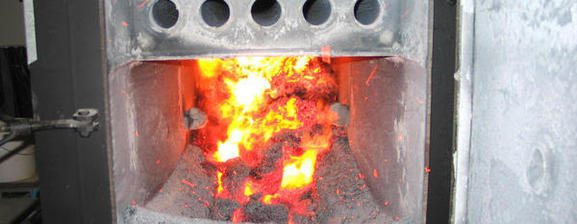
A mixture of straw and the fibrous solids in slurry can be co-fired in small-scale furnaces, but the combustion properties of the fibres are very variable and should be further examined.
Scientists at the Faculty of Agricultural Sciences have studied the effect of the co-firing of slurry solids and straw on energy efficiency and environmental impact. Photo: DJF
Small-scale stoker straw furnaces require only a few adaptations to make them suitable for the co-firing of slurry solids and straw.
The slurry solids originate from slurry separation where the slurry is separated into one or more liquid fractions and a solid fibrous fraction.
The solid fraction can be used as a phosphorus-rich, soil-amending fertilizer for plants or in biogas plants to increase the dry matter content and production of biogas. In areas with a high livestock density where there is a surplus of fertilizer-derived phosphorus, the combustions of the solids may be an option. In this way, CO2-neutral energy is produced and the phosphorus is concentrated in the ashes that can be used as a fertiliser component.
In a publication issued by the Faculty of Agricultural Sciences, the following issues have been investigated:
· The ratios of straw to slurry fibres that give the most practicable and optimal combustion
· How different types of fibre and mixtures of straw and fibre affect the energy efficiency and environmental impact when co-firing straw and the slurry solid fraction
· How different ratios pollute the environments by way of particulate and NOx emissions.
Following a number of experiments with the combustion of the slurry solid fraction in a small furnace (200 kW), the conclusion of the scientists is that small-scale furnaces can be used for the combustion of the slurry solid fraction with straw, but that there are also some problems associated with this.
The fibres often have a high water and ash content and the recommendation is therefore that the solid fraction should comprise at most 50% of the co-fired mix.
- Co-firing the solid fraction with straw has a positive effect on heat production. Nevertheless, even with the largest possible quantity of slurry solids, the energy production from the fibrous fraction is only about 20% of the total energy production of the furnace, while 80% originates from combustion of the straw, the scientists point out.
In addition to the relatively low contribution to the total energy production, the combustion of slurry solids also markedly increase the particulate emissions from the chimney compared with the combustion of straw. NOx emissions are, however, the same for the mix as for the straw alone.
The experiments also show that there are large differences in the flammability of the products and there is therefore a need to study this topic further. It should also be investigated whether it is possible to burn a larger proportion of slurry solids by injecting them in such a way that they do not transfer moisture to the straw or other biofuels.




