




The Producer: Complying with the German Kat regulations (Netherlands special part 2 of 4)
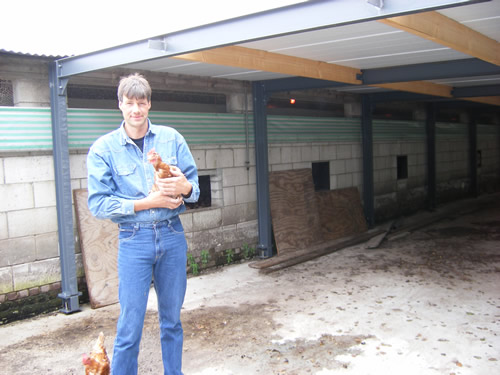
Free Range producer Ton van Ginkel keeps 23,000 hens at his farm at Putten, near Eindhoven. This is an area of great natural beauty, and is considered a very desirable part of the Netherlands to live in.
Mr van Ginkel comes from a farming family, so he learned how to look after laying hens from an early age. When he started out in egg production at his own farm, he initially produced Scharrel eggs but before long he decided to move into Free Range because of the price premium. He is pleased that he did; as he expected, the money is much better, and he also takes great pleasure in seeing his hens out on the range.
The flock
Mr van Ginkel's flock size of 23,000 is about average for Free Range production in the Netherlands. In general flocks vary from 18,000 to 30,000, but the size is usually limited by the amount of ground available, as planning permission is notoriously difficult to obtain in the Netherlands. When Mr van Ginkel and his wife bought their present farm, the four henhouses were already in place, and they had enough land around them to accommodate Free Range. "Four smaller houses are easier to manage than one big house," Ton van Ginkel comments. He adds that he used to find it quite difficult to keep the ranges in good condition. The grass grows fast here, and when it is too long the hens scratch it up by the roots. Now he mows it every week. It is a lot of work, but makes a big difference; the quality of the grass has improved tremendously since he began cutting it weekly. Sometimes his neighbour grazes his cows in one of the fields; this is an easier way of keeping the grass down, and the hens are perfectly at ease with the cows.
The flock is kept to 72 weeks, and all four sheds are restocked at the same time. Mr van Ginkel places his pullet order six months before changeover, and always orders his pullets from Verbeek, who have a very big local hatchery. Verbeek has its own advisors and its own veterinary services, and has an excellent reputation for supporting producers. His pullets are delivered at 17 or 18 weeks. They are not always reared on the same rearing farm. Once he has placed the order, Verbeek decides which of their 50 or so rearing farms will raise the chicks, selecting a farm where rearing conditions are a close match with housing conditions at Mr van Ginkel's farm. All Verbeek's rearing farms operate to the same rules and are KAT certified.
Previously Mr van Ginkel has always had ISA Brown, but his current flock is Lohmann Brown, and their performance, he says, has amazed him. "They have been over 90% for 41 weeks – it's unbelievable!" The only downside is that the eggs are quite small. "Small, but strong," he adds.
Collection
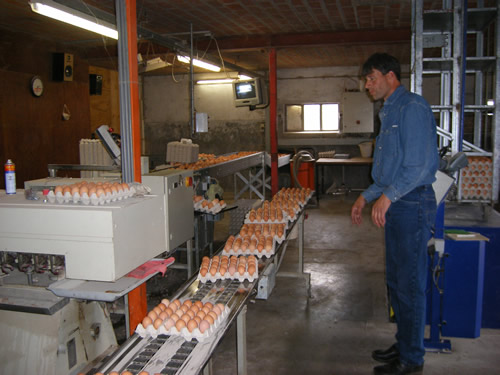
Eggs are conveyed to one central egg room on a separate egg belt from each house, on a route that takes them underground for much of the distance. Each belt can be monitored via a CCTV screen in the egg room. The system is very robust and has only ever broken down once (it goes without saying that when it did break down, the problem was underground so that a lot of digging was required!). Mr van Ginkel has also invested in a sophisticated in-line inkjet egg printer. Like other Dutch producers, he is totally convinced that on-farm stamping is the best way. "There is no question about it. The price differences are too big to take any chances," he says. "For some people, that might be a big temptation. In every industry there are good guys and there are bad guys." The fact that the industry is so tightly regulated gives him confidence, and he adds that his own packer is particularly vigilant. "Just once, I forgot to stamp 20 eggs," he recalls. "And I received a phone call about it immediately!"
Ton van Ginkel and his wife spend on average five or six hours a day working in the packing room and inspecting the hens in each houses. "But with a new flock, there are usually a lot of floor eggs at first, so this can mean eight hours' work or more until the birds have been trained," he adds.
Mr van Ginkel's eggs are packed by the Van Zetten packing station. At the moment the price is 7 cents per egg; this is based on the index price for Scharrel eggs of 6 cents, plus a 1 cent premium for Free Range. But the price can change from week to week. Earlier in the year it was up at 8 cents per egg, which was good; at 7 cents he is still in profit. Mr van Zetten takes all the eggs, including any seconds, which are usually paid at around 3 cents. It is likely that all Mr van Ginkel's eggs will go to Germany. Mr van Ginkel explains that Dutch Free Range producers can if they wish sell direct to German packing stations, and by doing so they could get higher prices; but in fact very few do. Around 96 per cent deal with Dutch packing stations because it is far more convenient.
Eggs are collected from Mr van Ginkel's farm once a week. Because the eggs have to be stored for up to six days, there is a temperature-controlled storage area to ensure that even in the summer, they do not deteriorate.
KAT
Mr van Ginkel does not in the least mind complying with Germany's KAT regulations. There are, he says, very very many rules. On the one hand he likes this because it protects the producer. He knows very clearly what the rules are, and as long as he complies with them all, he can be confident that he will never have a problem. On the other hand, it can make life difficult for producers when the rules change every three or four years. But as Ton van Ginkel says, if you want to be a Free Range producer in the Netherlands you have to accept KAT, because there is no other way to sell your eggs.
To comply with KAT's new ruling, Mr van Ginkel is currently engaged in building a Winter Garden onto each of his four henhouses. "The Winter Garden is a good thing," he says. "When there is a risk of disease, you can keep the hens safe in the Winter Garden. They are not outside exactly, but they are still Free Range because you are not keeping them inside." But this is a very big investment for him. He is doing all the work himself; he has been working on the project for three months, and he has to have all four Winter Gardens ready for inspection by 31st December. The biggest expense has been the metal frames which had to be made especially. "The iron frames were very expensive, and at the moment the egg price is too low to cover that." Two of the Winter Gardens are already taking shape: the frames are up and the concrete floors are laid – the only time that the birds had to be kept in was whilst the concrete was wet. He now has to put mesh round the sides and doors at the end, and ensure that the popholes are the correct height up from the new floor.
Mr van Ginkel has been very fortunate that his four houses are far enough apart to allow enough space to build a Winter Garden onto each of them. Even though he is not extending the site at all, he has had a long struggle to get planning permission for the Winter Gardens. He knows there would have been little chance of getting permission to extend the site, so if the houses had happened to be too close together, his only options would have been to take one of them down and cut back on bird numbers, or to go out of Free Range altogether.
Record-keeping
Each producer has his own unique farm number and a password that gives him access to the KAT database. Here, comprehensive data is stored on each flock, beginning with the breeder's and rearer's records, including vaccination, and tracking the flock throughout its life. Once the birds are laying, the producer must keep the records up to date by regularly entering his egg numbers; this must be done at least once a week.
The producer is also required to record and report any medication given to the flock. KAT controls drug use very closely, and in some cases all eggs may have to be destroyed following a course of medication, with a producer receiving as<




