




Troy – an alternative herbicide for the pulse sector
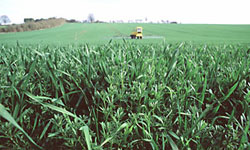
In a market where growers have become accustomed to more herbicides being revoked than introduced, Interfarm UK Ltd is making available an alternative post-emergence herbicide Troy for use in a wide range of broad leaved crops including beans, peas, and potatoes.
"Containing bentazone formulated as a 480 g/l user-friendly soluble concentrate, Troy delivers post-emergence contact broad-leaved weed control in dwarf French beans, runner beans, broad beans, navy beans, winter and spring field beans, combining peas, vining peas, linseed, narcissi and potatoes. It is active on a wide range of broad-leaved weeds including charlock, chickweed, cleavers, cranesbill, fool's parsley, forget-me-knot, mayweeds, volunteer rape, pennycress, pale persicaria, redshank, shepherd's purse and spurrey", advises Dr. David Stormonth, Technical Manager for Interfarm UK Ltd.
"This is the last year for many popular pulse herbicides such as simazine, products containing terbutryn or fomesafen, and also for cyanazine. Bentazone, as in Troy, is fast becoming one of the very few true post-emergence herbicides available in the pea and bean sector and the good news is that it is included in the Annex 1 positive list of the EC review. In dwarf French beans, runner beans, navy beans, linseed and winter field beans it can be used right up to before flower buds are visible and in broad beans up to before the 5 leaf stage for the single dose or before the crop exceeds 15 cm in height and before the 7 leaf pair stage for the split dose. This later timing also applies to spring field beans. In vining and combining peas its latest timing is before the flower buds can be found enclosed in the terminal shoot. In potatoes the latest timing is when the crop has reached 15 cms. So Troy offers excellent flexibility in timing that few other pulse herbicides can," says David.
"Troy is a contact herbicide in the diazinone group. It is absorbed by the foliage and not translocated. Best results from this herbicide will be obtained when sprayed in warm growing conditions, when weeds are small and actively growing. The first spray should be when weeds are at the cotyledon stage and the second spray 7-10 days after the first treatment. It is best to check that crop leaves are suitably waxed to prevent any crop scorch and that particular varieties are OK to spray. In some varieties in some crops such as dwarf French beans, runner beans and potatoes, an adjuvant can be added," points out Dr. Stormonth.
Troy 480 contains 480 g/litre bentazone formulated as a soluble concentrate. It is approved for use in dwarf French beans, runner beans, broad beans, navy beans, winter and spring field beans, combining peas, vining peas, linseed, narcissi and potatoes, post-emergence at dose rates between 1.5 l/ha and 3 l/ha, depending on the crop and tank-mix partners. It controls a range of annual broad-leaved weeds. It is rainfast in 6 hours and has no LERAP. It is packed in 5 litre pack.
For further comment and information, please contact Dr. David Stormonth, Technical Manager, Interfarm (UK) Ltd. on 01354 741414 or 07818 036506 (mobile).




