




Agroforestry expansion could cut food energy production by up to 45%
Food energy production — the total calories produced from farmland for human consumption — could fall by between three and 45% if agroforestry were widely adopted across the UK, according to new research from the University of Reading.
However, researchers say integrating trees into farmland could still bring significant benefits, including improved biodiversity, stronger soil health and greater resilience to climate change.
The research examined both the barriers preventing farmers from adopting agroforestry and the potential impacts of expanding the practice across England and Wales.
Only around three per cent of UK agricultural land currently uses agroforestry systems, despite growing interest among farmers and government support for tree planting.
Researchers worked with 220 stakeholders, including farmers, policymakers and environmental groups, to understand why agroforestry remains relatively rare in the UK.
Dr Amelia Hood, from the university’s Department of Sustainable Land Management, said interest in agroforestry is increasing but many farmers lack the knowledge needed to put it into practice.
“We're seeing strong interest in agroforestry, but interest isn't the same as implementation,” she said.
“Farmers need opportunities to learn from real farm examples and support to develop business cases.”
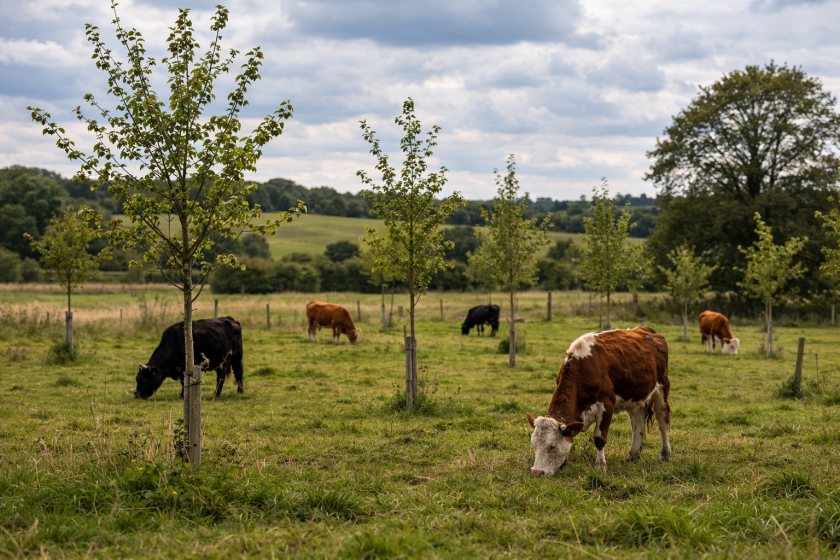
Agroforestry integrates trees with crops or livestock, helping improve biodiversity, soil health and climate resilience while maintaining food production.
Researchers identified a lack of practical knowledge about designing and managing these systems as a major barrier to adoption.
Many farmers said they would be more willing to adopt agroforestry if they could see successful examples operating on farms in their own region.
To address this gap, Dr Hood has launched the Trees-in-fields Network, a long-term research initiative bringing together demonstration farms across the UK.
The network will test different tree species and crop combinations under real farming conditions, helping farmers understand how agroforestry systems perform in practice.
The project will also help fill significant knowledge gaps around how tree-based farming systems can be managed effectively.
Stakeholders involved in the research also said trust in existing agricultural advice is relatively low, while the UK has fewer farmers receiving formal agricultural training compared with several European countries.
The report recommends developing an agroforestry accreditation scheme alongside government-funded education programmes to support farmers interested in adopting the approach.
A separate University of Reading study examined what could happen if agroforestry were expanded across England and Wales.
The modelling suggested agroforestry could significantly increase domestic production of fruit, timber and biomass — products the UK currently imports in large quantities.
However, the modelling also highlighted trade-offs.
Food energy production could decline if tree density becomes too high, with vegetables and cereal crops likely to be most affected. Livestock grazing systems would experience the least disruption.
Dr Tom Staton, lead author of the modelling study, said agroforestry systems can often be more productive overall than conventional single-crop farming.
“Most agroforestry systems are more productive overall than equivalent monocultures, especially in pasture-based systems,” he said.
“But widespread adoption would need to be accompanied by broader food system changes, such as reducing waste and shifts in dietary patterns.”
Researchers say the findings suggest agroforestry could play a far bigger role in the future of UK agriculture if farmers are given better access to research, training and trusted advice.
Dr Hood said greater investment in practical research, training and advice could help farmers adopt tree-based systems that support both food production and environmental benefits.
“Agroforestry is one of the few farming approaches that can deliver meaningful environmental benefits while maintaining, or even increasing, food production,” she said.
“These recommendations could help unlock its potential to support food security, benefits for nature, and progress towards lower emissions.”




