




New farming minister hears cost concerns on Surrey dairy visit
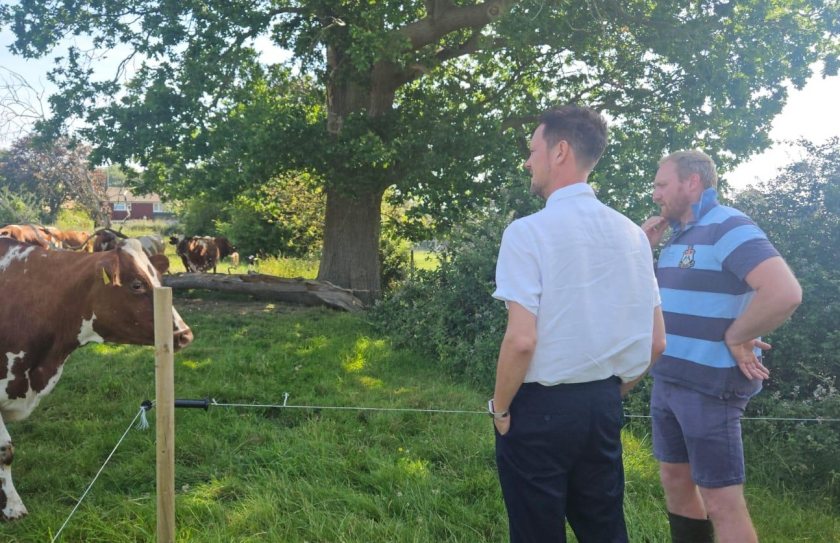
The government’s new food security and rural affairs minister has heard first-hand how small dairy farms are balancing nature recovery with rising costs, policy uncertainty and the need to stay commercially viable.
Stephen Morgan, who was recently appointed Minister of State for Food Security and Rural Affairs, visited Brays Farm in Nutfield, Surrey.
The visit came after NFU President Tom Bradshaw also hosted Mr Morgan on his Essex farm during the minister’s first week in the Defra role, where discussions focused on rising input costs, climate change, food production and environmental delivery.
At Brays Farm, Mr Morgan met farmers Matt Elphick and Betsie Edge, who run Nutfield Dairy, to learn more about their pasture-based system and the realities of running a small-scale dairy enterprise.
The visit also gave the farm an opportunity to raise concerns over energy costs, drought resilience, grant complexity and the need for clearer agricultural policy.
Brays Farm is owned by the Countryside Regeneration Trust, which supports tenants to farm in ways that benefit both food production and nature.
Mr Morgan was joined by private secretary Calum MacDonald and Paul McGuinness, Deputy Director for Environmental Land Management Schemes.
Matt led the group on a tour of the farm, showing how rotational grazing is being used to improve soil health, biodiversity and resilience to extreme weather.
He explained how the farm’s pasture-based dairy system uses cows as part of the process of regenerating soils.
“We started with a walk to see the cows and I explained how we farm and graze the pasture, how we manage the rotations to regenerate the soils and how we use the cows to help achieve that,” Matt said.
He added that the farm keeps calves at foot and is working towards becoming “100 per cent pasture-fed”.
The group also met Betsie, who sells Nutfield Dairy products directly to customers from the couple’s converted milk float, with Mr Morgan sampling a milkshake and buying cheese during the visit.
Matt said the visit was also used to discuss the financial pressures facing farmers.
Although Nutfield Dairy is a small-scale operation, he said it still faced many of the same fixed energy costs as larger farms because of the need to run milking and refrigeration systems.
“We talked about the financial pressures farmers face,” he said.
“Although we are a small-scale operation, we still have many of the same energy costs as larger farms because we need to run the milking parlour and refrigeration systems full time.”
He also highlighted the impact of last year’s prolonged drought and the need to build more resilience into farming systems.
“I explained that buying in feed was very expensive, but we also talked about how regenerating soils helps create more resilient pasture with better biodiversity, stronger root systems and improved water retention.”
Matt also told the minister that farmers needed more certainty when policies changed, saying clear notice was essential so farm businesses could plan ahead and grant schemes needed to be easier to apply for.
“I stressed the importance of clarity and advance notice when policies change, so farmers can plan effectively,” he said.
“I suggested that grant schemes should be simpler to apply for, as many farmers simply do not have spare hours to spend on lengthy applications.”
The visit also covered future environmental and diversification plans at the farm, including further hedgerow planting and possible agroforestry.
Matt said the measures could improve soil structure, provide shade for cows and create additional wildlife habitat.
Mr Morgan also asked about diversification, but Matt said it was often presented as an easy way to boost farm income when, in reality, it could be difficult to deliver alongside the demands of running a farm.
“While diversification is often presented as an easy way to increase income, starting a new business alongside farming is a significant undertaking when time is already in short supply,” he added.
Kerriann McLackland, head of estates at the Countryside Regeneration Trust, said the visit had been a chance to discuss how policy could support both farming businesses and nature recovery.
She said Mr Morgan had told them it was his first visit to a livestock farm since becoming minister, and had asked detailed questions about economic viability, agri-environment schemes and how farmers could be better supported.
“He seemed genuinely interested in understanding the realities of farming and our suggestions of how policy could be used to make that easier,” she said.
Ms McLackland said the discussions also focused on the need for agri-environment policies that work for farmers as well as nature, alongside the certainty businesses need to plan for the future.




