




New farming minister hears warning over rising costs
Britain’s new farming minister has been warned that rising costs, shrinking margins and extreme weather are making it increasingly difficult for farmers to produce the nation’s food.
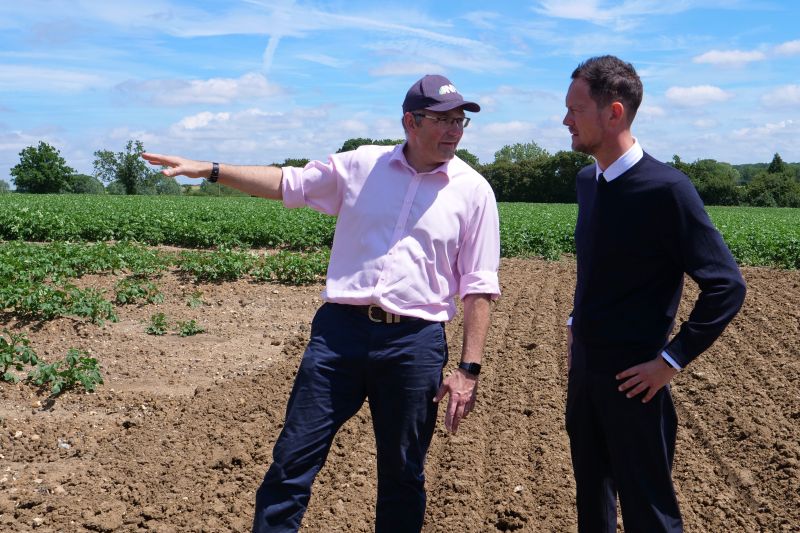
NFU President Tom Bradshaw hosted Stephen Morgan on his Essex farm during the minister’s first week as Food Security and Rural Affairs Minister.
It was Mr Morgan’s first farm visit since his appointment, with the Portsmouth South MP taking over the Defra brief at a time when farmers are seeking clearer direction on food production, trade and rural policy.
He replaces Dame Angela Eagle, who moved from Defra to a national security role after serving as Food Security and Rural Affairs Minister from September 2025 to June 2026.
The visit focused on the pressures facing British farmers and growers, including rising input costs, climate change and the need to build greater resilience into UK food production.
The NFU described the meeting as an opportunity to discuss the increasing difficulty of producing food while also delivering environmental improvements.
Mr Bradshaw said it was important to show the minister the pressures facing farmers first-hand.
“Although we spoke earlier in the week, it was great to have Stephen Morgan out on my farm during his first week in the job to discuss how it is getting increasingly harder for us to produce the country’s food and deliver for the environment,” he said.
The NFU President warned that British agriculture was under severe pressure from rising costs, with fuel and fertiliser among the key concerns.
The warning comes after agriculture was flagged by the Bank of England as a sector facing “elevated financial stress”, with rising fuel, fertiliser and energy costs continuing to squeeze farm businesses.
The bank identified agriculture alongside hospitality, retail and construction as sectors under growing financial strain amid rising costs and weaker confidence.
“I explained how British agriculture is under immense economic strain, driven by the conflict in the Middle East, with margins being completely eroded by rising costs and a lack of transparency over the pricing of fuel and fertiliser,” Mr Bradshaw said.
Talks also covered the growing impact of climate change and extreme weather on farms.
Mr Bradshaw stressed that building resilience across the sector was essential if the UK was serious about protecting food supplies.
“Building resilience into UK food and farming is crucial,” he said.
“We have heard many times from this government that food security is national security – and that has to be the mindset.”
Farmers needed confidence to invest in their businesses if the sector was to increase productivity and support national food security, he added.
Mr Bradshaw urged ministers to take immediate steps to improve farm resilience by reforming planning and regulation, including permitted development rights for reservoirs and more flexible abstraction licences.
He argued that these changes would help farmers and growers better manage water during increasingly volatile weather.
“I stressed the urgent need to prioritise food production and unlock growth by giving farmers confidence to invest in their businesses,” Mr Bradshaw said.
“A first step would be planning and regulatory reforms that support farmers and growers such as permitted development rights for reservoirs and flexible abstraction licences.”
The NFU described the meeting as constructive, while warning that major challenges remained for the industry.
Mr Bradshaw argued that the government and farming sector would need to work together to strengthen food security and support the future of British agriculture.
“We agreed there is much work to do,” he said.
The NFU warned that stronger policy support would be vital if farmers are to keep producing food for a growing population while protecting and enhancing the countryside.




