




Farmers delay mass protest while pushing for emergency support bill
Plans for a UK-wide farmer protest over tax and fuel costs have been paused at a critical moment, as campaigners shift focus towards political talks and emergency legislation.
Farmers For Action (FFA) had been preparing to coordinate a nationwide demonstration, backed by farming organisations across the UK, but has stepped back from setting a date — for now — as it seeks engagement with government and Westminster committees.
The group confirmed it had written to Chancellor Rachel Reeves and Environment Secretary Ed Miliband requesting urgent talks, but had not received a response within the expected 14-day period.
At the same time, FFA has moved to push what it sees as a longer-term solution, requesting a meeting with Westminster’s EFRA Committee to discuss a proposed “Farm Welfare Bill”.
The bill would aim to guarantee farmers are paid at least the true cost of production, linked to inflation, plus a margin — a measure Farmers For Action co-ordinator William Taylor said could ease what he described as “massive corporate food retail induced financial pressure”.
He argued that such legislation could have an immediate stabilising effect, giving banks the confidence to support farm businesses while the policy is phased in.
Mr Taylor said the decision to pause protest plans was also influenced by political uncertainty at Westminster, with speculation over potential changes at the top of government.
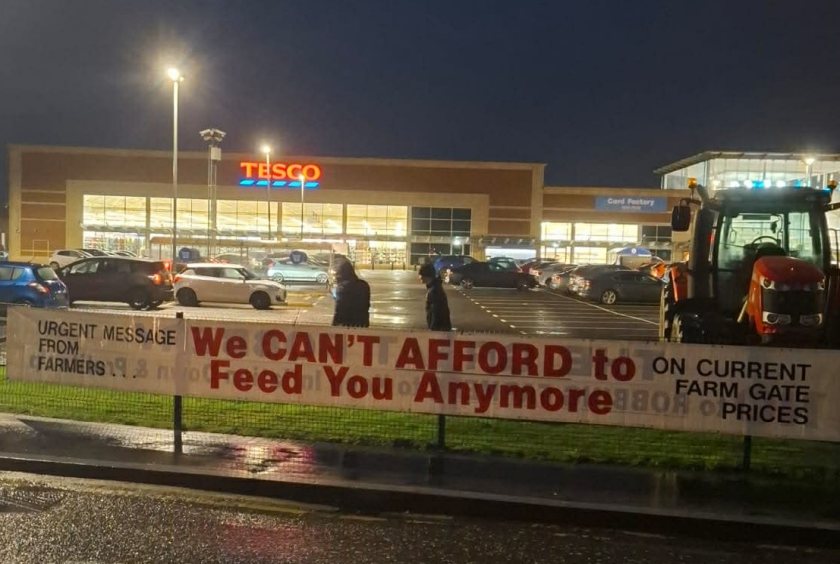
Despite holding back on immediate action, the group made clear the pressure facing farmers has not eased. “We can’t afford to feed you anymore!” Mr Taylor said, underlining the severity of the situation.
The warning comes as farm businesses face a deepening financial squeeze, with rising input costs colliding with falling returns.
Fuel and fertiliser prices have surged amid global energy instability linked to tensions involving Iran, with disruption in key supply routes driving up costs across the sector.
These pressures are being felt across both arable and livestock farms, particularly during key periods such as spring fieldwork and lambing, when demand for inputs is at its highest.
Latest analysis from Andersons shows agricultural input inflation reached 7.6% in March 2026— more than double general inflation at 3.0% and above food inflation at 3.2%.
At the same time, farm output prices have fallen by 6.5% year-on-year, leaving producers caught in a tightening squeeze between rising costs and weakening returns.
FFA said it hopes to secure a meeting with EFRA Committee chair Alistair Carmichael to advance discussions on the proposed bill, positioning it as a potential lifeline for the sector.
No response had been received from government at the time of writing.
For now, the protest remains on hold — but campaigners signalled it could return if talks fail to deliver meaningful progress, with pressure on both government and retailers continuing to build.




