




Keep up robust protection against foliar and tuber blight through until harvest
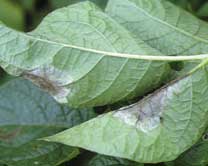
Although not as severe as last year, there has been consistently high blight pressure as indicated by a run of Smith Periods throughout the early and mid-season and growers are being advised to keep spray intervals tight and to use robust fungicide treatments with both foliar and tuber blight protection from now on, according to Dow AgroSciences.
"Produced on foliage and stems, zoospores are the causal agents of tuber blight and these motile spores are produced when temperatures get below 15ºC. These zoospores then drop off or are washed off into the soil through which tubers are lifted. But it is not always the crop with most obvious foliar blight that has the highest tuber blight. Very little inoculum on the foliage is needed for spores to be washed down into the soil and infect tubers. So every effort must be made to keep disease out of the crop from tuber initiation onwards," says Andy Leader, Principal Biologist for Dow AgroSciences.
He points out that an effective blight programme aims to protect against foliar blight and prevent zoospores from being produced. "Not all fungicides have proven activity on zoospores. Zoxium in the protectant fungicide Electis stops their formation and release. Other fungicides act on zoospores once they are released. Considering the different modes of action on zoospores, it is advisable to use Electis early on in the programme from stable canopy or tuber initiation onwards, so reducing the initial zoospore population. By reducing the zoospore loading as early as possible after tuber initiation, this will optimize the activity of fungicides with direct zoospore activity," he advises.
"Blight fungicide choice from mid-season programmes onwards makes a significant difference in reducing tuber blight and improving the quality of the end sample. Growers should use products with known, proven zoospore activity which can be mixed with desiccants so that the crop is kept clean to the end and tuber quality and yields are protected. But you must be aware of all the in and outs of the product label so that you are certain you don't contravene any label recommendations or protocols, particularly when it comes to number of sprays and alternating products with different modes of action," warns Andy.
"The protectant fungicide Electis has approval for up to ten applications per season, no restrictions on applications in blocks or sequences, one hour rainfastness, excellent blight protection, proven zoospore activity, compatibility with desiccants and a 7 day harvest interval, offering unsurpassed flexibility and making it very easy to integrate into any programme. If kickback is needed, as was the case in the majority of situations last year, cymoxanil should be added to Electis," advises Mr. Leader.
"Electis is a strong and effective protectant fungicide, outperforming fluazinam and cymoxanil plus mancozeb in trials over many years and it is categorised as one of the top foliar blight fungicides by a panel of European industry experts. It is a highly suitable product to integrate into any blight programme, enhancing any programme," he comments.
Electis contains 8.3% w/w zoxium and 66.7% w/w mancozeb, formulated as a WDG. It is recommended on all varieties of potatoes at spray intervals of 7 to 14 days. It has a dose rate of 1.8 kg/ha in 200-600 litres of water per hectare. It has a maximum number of treatments of 10 per crop and a harvest interval of 7 days. It is packed in a 3 ha pack (5.4 kg).
For further information, please contact
Andy Leader, Dow AgroSciences on 01462 457272 or 07802 225769 (mobile).




