




Over 200 attend West Midlands potato day
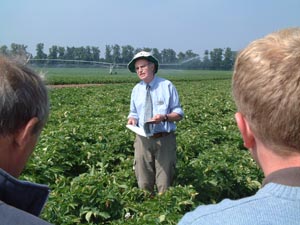
Over 200 growers and members of the potato industry were presented with the latest advice from the BPC and independent experts at the West Midlands Potato Day on Wednesday 6th June.
TAG's Denis Buckley discussed water use in potato crops at the event, hosted by Richard Solari and sponsored by The Environment Agency, Greenvale AP and supported by McCain Foods (GB) Ltd. "The industry must now have the capacity to irrigate more than 80% of the potato acreage, but due to higher transpiration rates, most growers cannot cope with a dry season such as 2006," he said.
"Media publicity always emphasises extremes in terms of annual temperature rises," Mr. Buckley noted. If global warming becomes a reality it is important to manage water effectively as a resource. But the situation is improving as more investment is made by growers.
Mr. Buckley advised, "The closer a soil is kept to field capacity the higher the yield, however this has to be managed during the season. Good rainfall forecasts are required during early irrigation. Late irrigation is good for quality but harvesting and storage rots should be considered."
Tape irrigation has benefits on a small scale and currently does not require an abstraction licence, but management and monitoring is difficult on larger acreages. "Tape irrigation is not, and is unlikely to ever take the potato-growing world by storm," he added.
Eric Anderson of Scottish Agronomy highlighted soil management. "This is critical in terms seasonality changes and minimising down-slope erosion, wind erosion and flooding risk", he said. "Crops grown on slopes of more than 3% are at risk to soil erosion." Management is important - if soil is dumped on roads or houses, insurance may cover the first incident, but civil action can be taken thereafter.
"Tied ridgers and the Aqueel can minimise erosion and also maintain water in a dry season. The Aqueel potentially can achieve 192,500 indentations per Ha, with a capacity of up to 1 litre per indentation and benefit of 50% reduction in field sediment loss."
The BPC's Iain Dykes discussed new research on Dickeya dianthicola, one of the Erwinia chrysanthemi (Ech) complex of bacteria that causes rots and crop losses.
"D. dianthicola has caused limited economic loss to date in the UK. Climate change and continued introduction of the pathogen to the UK could result in this becoming a serious economic threat."
D. dianthicola requires greater understanding and Mr. Dykes urged growers to report suspected cases. A BPC-funded project is underway to build up geographical knowledge of the problem. But continued control of the threat could give the industry competitive advantage. "Israel is expected to introduce zero tolerance on imports by diagnosis," points out Mr. Dykes. "The current BPC guide, 'Managing the risk of soft rot and Blackleg', provides the advice for control. Seed grown under the Safe Haven Scheme ensures zero incidence."
The high level of attendance at the event shows the UK potato sector is responding proactively to the new soil and water legislation reported, BPC agronomist, Kate Jackson. "With these workshops the BPC is leading the way on interpreting the legislation and discovering the production benefits for growers. I'd urge all growers to find out where their local event is and attend."




